

Kristina King of Sweden
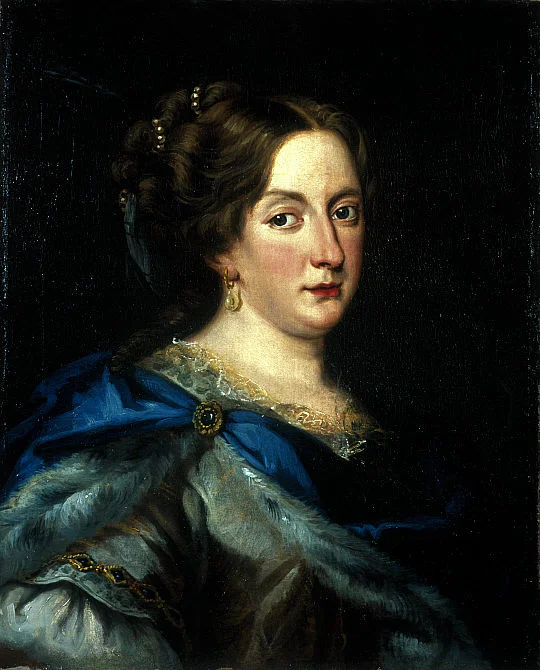
The painting “Christina of Sweden” by Jacob Ferdinand Voet. It features a portrait of Christina, a white person with brown hair pulled back with gold pieces. They wear a green and blue dress with gold details, gold earrings, and red lipstick. They smile just slightly and stare at the viewer with dark eyes. Their cheeks and nose are flushed pink.
“I was born, have lived, and will die free.”
– Kristina, King of Sweden
King Kristina of Sweden was a monarch born in 1626, initially assigned male at birth. The nurses would later retract this and assign Kristina as female. Throughout the rest of her life King Kristina would continue to confuse and contradict gender roles. So much so that questions are still being raised today as to how to understand Kristina’s identity.
In eras and areas where queerness is not discussed as an identity, any attempt to understand what words to use for a person’s experiences becomes complicated. Many will say not to try to use labels in these cases, which is a legitimate perspective. Unfortunately, this perspective is often twisted to excuse or justify the erasure of queerness from history. When naming identities, self-identification is king, but when a person had no opportunity to self-identify under a label, all suggested labels are speculation. And while speculation is not fact, it is also not useless. Such is the case with Kristina of Sweden. There is an element of interpretation at play, as there are many labels Kristina may have fallen under. What is certain is that they were not heterosexual, cisgender, and endosex.
The first thing that must be discussed is how to address Kristina. For a period of their life, they went under the name Kristine Alexandre, naming themself after Alexander the Great. It is difficult to find when or if that stopped. While it is possible they were still using that name within their personal life into their later years, they were publicly using the name Kristina for themselves again by the end of their life. Since that is the most recent and most evidenced, it is the name this article will use.
As for pronouns, one could argue that any pronouns would make sense. There is good evidence to suggest they could have been a transgender man, a nonbinary person, an intersex person, or even a cisgender woman. The use of she/her/hers pronouns reflect what she used in her life, and will be used going forward. The title of king instead of queer comes from her manuscript where she would identify with and use the title of “prince” rather than “princess”.
This is not the first time Kristina’s gender has been a point of contention; it has mystified people since she was born. In December of 1626 in Stockholm, Sweden, the nurses initially announced the birth of a son. It took a whole day for anyone to admit that the child had been born with genitalia traditionally used to indicate womanhood, out of fear for how the king would react.
King Gustavus Adolphus had been trying for a male heir for some time and was known for his nasty temper. To everyone’s surprise, he took the news rather well, and he decided to make Kristina his heir, treating her as he would a prince.
There are many theories about how Kristina was identified at birth; some suggest she was just a very hairy baby, while others believe they may have been intersex. An examination of her bones was not conclusive in proving this idea, but it remains a possibility in the long line of theories about her identity.
Regardless, in being raised as a prince, she was given the best education and trained in the art of war. According to their father's wishes, she was crowned King of Sweden after his death, but they were a king like none had seen before.
Having access to the type of education that people assigned female at birth at the time could scarcely hope for, Kristina soon became well known for her thirst for knowledge and intelligence. In a letter, a friend of hers, Father Mannerschield, wrote:
“She understands ten or eleven languages, to wit, Latin, Greek, French, Italian, Spanish, High-dutch, and both Swedish tongues, the Finnish, and, if I be not mistaken, the Danish. She can read likewise, and in some measure, understand Hebrew and Arabic. She hath read and understands all the ancient poets. The modern poets, both Italian and French, she hath almost by heart. She hath dived into all the ancient philosophers. She hath read many of the ancient fathers—but commends chiefly Nazianzen.— Her memory seems to be more than human. She seems to be ignorant of nothing, and to forget nothing.—She tires out daily I know not how many secretaries, to whom she dictates and corrects, turns over and finishes everything herself.”
Kristina had access to not only an extensive collection of books, but the men who taught them were among the most respected scholars available—educating her well and challenging some of the time’s prejudices in their discussions. This included questioning the religious rivalries that had fed The Thirty Years' War against the Catholics.
Soon after she was crowned king of Sweden, Kristina would call for peace, which she achieved in a relatively short time. However, it was not a popular choice, and they were encouraged to be more like their mother—to sit back and let their advisors, and eventually their potential future husband, control matters of state. Kristina rejected that expectation firmly.
Though her time as ruler saw many advisors, it is clear that this was due to the value placed on knowledge and new perspectives rather than a case of dependence. From the letter mentioned above, Father Mannerschield wrote of their position in regards to their advisors:
“She says that it is a duty required of her by her Maker, to take the best care she can of the concerns of the kingdom; that she will do what in her lies; that if things succeed not as may be wished, she shall have this comfort, that nothing hath been wanting on her part.
She administers and finishes all public business herself. The ambassadors of potentates transact everything with her in person, and are remitted to no minister or secretary. When she gives public audiences to ambassadors, she alone makes all the answers to them.
It is scarcely to be believed, but ‘tis what I see every day, that these very Swedish generals, whose name and arms have so long made Germany tremble, in her presence stand speechless, (...) and seem to be in the greatest confusion. She was scarce seven years old when she lost her father: who could believe that the daughter, at the age of twenty- seven, could so establish her power in a kingdom, the constitution whereof is pretty free, as to rule alone, depend upon the wills and councils of none, be under the influence of none, but alone administer, conduct and finish everything? ”
One of Kristina’s top priorities throughout her entire life was to surround themselves with art and knowledge, bringing people from all over Europe to teach and later learn with them. She befriended some of the most educated people of the time and worked to learn just as much as them. By all accounts, she succeeded, amassing Sweden's library during their time as king. She moved the country from war and conflict to education. As part of this legacy, she established the first countrywide school ordinance and started the first newspaper, Ordinari Post Tijdender ("Regular Mail Times"), which continues today as the world's longest-running newspaper.
Through all of this, she also publicly challenged what was expected of someone in her station who was assigned female at birth. Father Mannerschield wrote:
“She hath nothing feminine about her but the sex. Her voice is masculine, and so is her manner of speaking, her movement and gesture.
I see her on horseback almost every day: and tho’ she fits in her saddle as ladies do, yet she shakes and bends her body in such a manner, as that one who is not very near her, would take her for a man. When she rides, she wears a hat, and a waistcoat after the Spanish fashion. Her skirts alone discover her to be a woman. She keeps but one foot in the stirrup, and yet she rides so hardily, that none are able to keep up with her. One would think her flying rather than running. Our master the king of Spain hath desired her picture, in a riding posture, to be sent to him. Her riding-garb is to far from being costly, that I scarce believe it is worth four or five ducats.
At court she wears clothes so very plain, that I never saw any gold or silver about her but a single ring. She takes no manner of care in decking her person; she adjusts her hair but once a week; and sometimes only once a fortnight. On Sundays she spends half an hour in dressing, on a week days scarce a quarter. I have sometimes, when I was discoursing with her, seen her smock stained with many spots of ink. Occasioned by her writing much; and even sometimes is torn. When she is advised to bestow more pains in adorning her person, she says that it is an idle employment.”
Kristina was known to dress in traditionally masculine clothing and refused to marry and produce an heir. She was reportedly so vocally disgusted by pregnancy that their ladies-in-waiting would hide their pregnancies to avoid being fired.
To avoid the fate the Swedish people wished upon her—namely marrying their cousin—she chose instead to adopt him and named him the prince. Despite the good she brought the country and her skill, she abdicated the throne to her adopted son after only ten years as king.
Aside from her disgust toward marriage and pregnancy, there may have been further reasons for her avoidance of men. This is where it gets complicated. It is well known that Kristina slept with Ebba Sparre, one of her handmaidens. She introduced Sparre as "my bedfellow" and took little effort to hide it. After their relationship ended, so did evidence of Kristina's interest in pursuing any relationships.
It could be she was heartbroken, or she may have been somewhere on the asexual spectrum, or that the evidence is just not widely known. One possibility is that she was what would now be called demisexual, requiring a solid emotional connection with someone to be attracted to them, and Sparre was one of the few with whom she felt that connection.
In her writing, Kristina would say things suggesting this view of love, writing:
“People do not always love what they esteem; but they always esteem what they love.”
Or:
“Nothing pleases, nothing touches, but the beloved object.”
It must be noted that the works of King Kristina are, more than anything else, contradictory. So, while there can be many quotes from her to suggest one view of love and sexuality, others seem to suggest an entirely different view.
Throughout her life, she interacted with philosophers often and can be viewed as a philosopher in her own right, and one of the things that interested them the most was the nature of love and passion. While those are not particularly obscure topics, the depth of her interest is a little more remarkable. She had a fascination with the Catholic views of celibacy and the virgin Queen Elizabeth the First’s life.
It is also clear that this interest transferred to her personal life, as when she announced her decision to abdicate the throne, they said to their councilors:
"I do not intend to give you reasons, [I am] simply not suited to marriage."
This seems to indicate more than just a lack of suitable partners. Whatever the reason, she noted in her memoirs that Ebba Sparre was the one love of her life. Even after her relationship ended and Kristina left Sweden, she attempted to reunite with her dear Ebba, only to be blocked by the Sparre family.
That said, it's entirely possible that she was what would now be called an allosexual person attracted to women and just kept her relationships quiet as she got older. It wouldn't be surprising, given the number of nude paintings of women she had adorned throughout her home. It is clear, whatever level of attraction she may have felt, she had no interest in marriage as it existed at the time. She died unmarried, and, as relationships with women weren't counted, she is widely considered a virgin.
As for gender, there is no settling argument. In general, much of her life was spent seemingly to confuse any historians trying to understand her. Her conversion to Catholicism, her desire to become a monarch again later in her life, and her belief system remain hotly debated topics.
In some cases, though, it seems that the debate is made out of nothing. One of the more clear parts of Kristina’s life after abdication was her support of Jewish people and the Jewish community. Although some have become very invested in either erasing or delegitimizing this activism, the reality of it seems very clear.
Kristina, throughout her life, was passionate about religious tolerance, and one of the more popular theories as to why she converted to Catholicism in the first place was to increase tolerance for Catholic people after The Thirty Year War. In her later life, she would travel and stay with Jewish friends, using her sway as a well-known and respected figure to support her efforts for change while also making a life for herself. This is shown from things as simple and relatively small as sending letters to authorities to argue against the antisemitism that was affecting a Jewish friend’s trading business, and as large as threatening the Pope that she would convert back from Catholicism if he didn’t step in to stop a tradition of throwing stones at Jewish people in the streets.
While not all her efforts were successful, and criticizing her work is entirely acceptable, the criticism often seems odd. Specifically, trying to brush away all of it as misguided and a sign that she was foolish and easily influenced or suggesting she only did any of this because she planned to convert the Jewish people in her life to Catholicism. There is little to no evidence for either of these suggestions, so the motivations for these assertions are somewhat questionable as one pulls them into the light.
That being said, criticizing, discussing, and questioning a person’s life and actions in the past is not necessarily a bad thing, even if it can sometimes be used as a guise for other less noble goals.
While this article has suggested that King Kristina was a transgender demisexual person, there is also evidence to support alternate theories. An essential part of discussing Kristina, and many other historical queer figures, is recognizing that discussing their identity is not inherently harmful. For one, they are dead. No one is outing them, endangering them, or enforcing a label when they have chosen another for themself. Additionally, it is not harmful to their legacy to suggest that they were transgender, on the asexual spectrum, or attracted to women because those are not harmful things. Ascribing modern labels to historical events and peoples is a large part of studying history.
Sometimes, a modern lens can lead to a better understanding of the past. As this article is not written in Swedish, it is already removed from the language Kristina may have used for herself. This argument against using modern language when examining historical events seems to come up most often when queerness is introduced. The word "volcano" is used when discussing Pompeii, but the citizens of Pompeii had no such word for the thing that killed them.
In the end, it is better to tell a story with questions and no real answers than never to tell the story at all. Kristina was a remarkable person, no matter what language she would have identified with today, and she deserves to have her story told as a whole.
She loved and slept with a woman. She dressed in men's clothes and lived the childhood of a young man. She named herself after Alexander the Great and was known as one of the most educated and intelligent people of her time. None of this can be removed without losing something incredible; the true, complicated, and contradictory story of a beloved King of Sweden.
[Disclaimer: some of the sources may contain triggering material]
Bawer, B. (2004, November 7). ‘Christina, Queen of Sweden’: A Royal Mess. The New York Times. Retrieved from http://www.nytimes.com/2004/11/07/books/review/christina-queen-of-sweden-a-royal-mess.html
Boothe, K. (2015, December 7). The unconventional reign of Sweden’s queer Queen Christina. Women in the World. Retrieved from https://womenintheworld.com/2015/12/03/the-unconventional-reign-of-swedens-queer-queen-christina/
Buckley, Veronica (2004). Christina; Queen of Sweden. London: Harper Perennial.
Cavendish, R. (2004). Abdication of Queen Christina of Sweden. History Today, volume 54 (issue 6). Retrieved from http://www.historytoday.com/richard-cavendish/abdication-queen-christina-sweden
Christina, Queen of Sweden (1753). The Works of Christina Queen of Sweden. D. Wilson & T. Durham. Retrieved from https://books.google.ca/books?id=7jhcAAAAcAAJ&printsec=frontcover&source=gbs_ge_summary_r&cad=0#v=onepage&q&f=false
Conley, J. J. Kristina Wasa (1626-1689). Retrieved from https://iep.utm.edu/wasa/
Franzen, C. (2020). Christina’s Cool. In Hermanson, G. & Jørgensen, J. L. (Eds.), Exploring Nordic Cool in Literary History (pp. 269-283). John Benjamins Publishing Company. Retrieved from https://books.google.ca/books?hl=en&lr=&id=wWsHEAAAQBAJ&oi=fnd&pg=PA269&dq=Kristina+wasa&ots=v9njtWbbH8&sig=G2RhgXHL_YydpG9UgH7hGgrz3YA#v=onepage&q=Kristina%20wasa&f=false
Waithe, M. E. (Ed.). (2012). A History of Women Philosophers: Modern Women Philosophers, 1600-1900. Springer Science & Business Media. Retrieved from https://books.google.ca/books?hl=en&lr=&id=4eHUBgAAQBAJ&oi=fnd&pg=PT11&dq=Kristina+wasa&ots=ELoDTzJ-Ln&sig=tYE7rjp87x6eFl29nzst6A1_JAk#v=onepage&q=Kristina%20wasa&f=false
Woods, K. (2003). Christina of Sweden. Kings College. Retrieved from http://departments.kings.edu/womens_history/christina.html
Last edited August 4th, 2025

