“Juan José Cabezudo…lived during the time of Peru's independence. For us, it's very important that the first [openly] gay man who was totally visible in Lima in the nineteenth century was a Black person.”
– Roland Alvarez
Widely considered the first openly homosexual figure in Peruvian history, Juan José Cabezudo had, by the early nineteenth century, also become one of the most recognizable public figures in Lima despite their modest social and economic position. An Afro-Peruvian cook, street vendor, and culinary entrepreneur, Cabezudo built a reputation largely through the preparation and sale of tamales, sweets, and other prepared foods that circulated through the city’s busy streets, plazas, and elite social gatherings. But while they were known for their culinary endeavors, Cabezudo’s visibility within Lima also extended beyond the food they prepared and served. The combination of their perceived effeminate dress, gestures, speech, and demeanor resulted in them becoming publicly identified as “el maricón,” a pejorative term used in nineteenth-century Peru toward men understood to be feminine or sexually nonconforming. Despite the hostility embedded in this label, Cabezudo was able to live freely and openly, occupying a highly visible and socially legible role within the city’s urban culture and becoming one of the clearest documented examples of gender nonconformity in early republican Latin America.
Given the time period, precise details regarding Cabezudo’s early life remain difficult to fully reconstruct. However, historians generally posit that they were born around the turn of the nineteenth century and situate them within Lima’s large Afro-Peruvian population during the late colonial and early republican periods. Additionally, given both the historical period and the limited surviving documentation surrounding Cabezudo’s life, it remains impossible to know how they may have understood their own gender or sexuality. And because contemporary identity categories and terminology did not yet exist in the same way they do today, this essay uses they/them pronouns while recognizing the limits of retroactively assigning modern labels to historical figures.
During this period, though, Lima’s city streets functioned as dense sites of racial mixture and informal commerce, with food vendors, artisans, servants, performers, and market sellers forming a highly visible part of everyday public life. Culinary labor in particular became one of the limited avenues through which Afro-Peruvians could potentially accumulate income and gain social recognition. It is thus within this limiting environment from which Cabezudo emerged, garnering attention as a widely known cook whose clientele reportedly crossed class boundaries. Some accounts claim that Micaela Villegas — a famed actress and companion of the Viceroy of Peru Manuel de Amat — was among Cabezudo’s most well-known customers, while others link them to serving elaborate public banquets held during Peru’s independence era, including celebrations associated with Simón Bolívar.
Perhaps more famously, however, is the fame that Cabezudo achieved beyond their culinary success. Throughout nineteenth-century descriptions written by the likes of French traveler Max Radiguet or Peruvian writer Ricardo Palma, they repeatedly appear as a public personality whose gender presentation attracted attention, fascination, ridicule, and most importantly, artistic documentation. Cabezudo was often referred to by the nicknames “Ño José” and “La Pepa,” the latter being a feminized variation of José or Josephine. Most observers described them as possessing an exaggeratedly feminine voice, mannerisms, and style of dress, while some repeatedly framed their appearance as both comedic and scandalous. Radiguet, for example, described Cabezudo as possessing an “escandalosa popularidad,” or scandalous popularity, noting that their culinary reputation was deeply tied to their highly theatrical public persona.
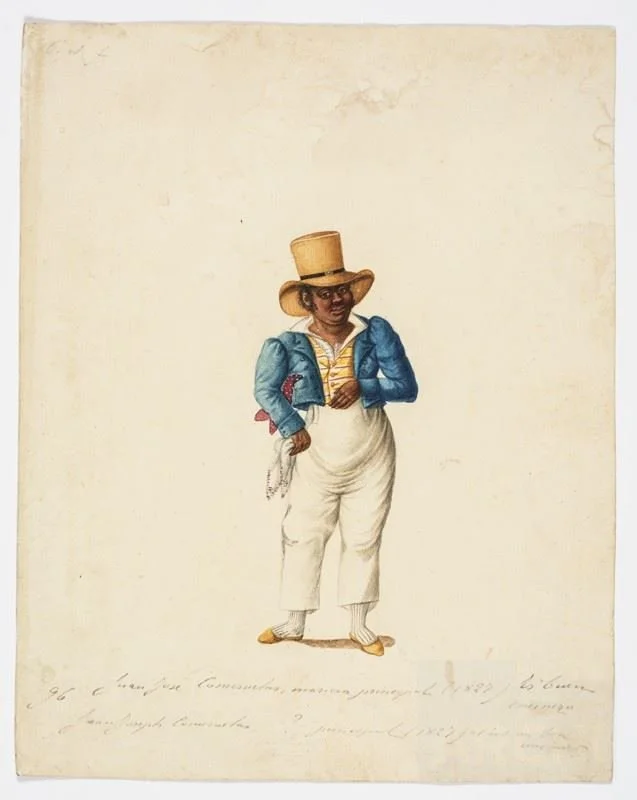
This public visibility ultimately transformed Cabezudo into one of the best-known subjects within nineteenth-century Peruvian “Costumbrismo,” the artistic tradition devoted to documenting everyday local “types” and customs. Perhaps most famously, the Afro-Peruvian artist “Pancho” Fierro—one of the most important chroniclers of Limeño street life—painted Cabezudo in the watercolor “Ño Juan José Cabezudo el maricón.” Another watercolor, attributed to Francisco Javier Cortés, referred to them even more directly as “maricón principal.” At once both documentary and caricatural, these images situated Cabezudo among the vendors, laborers, entertainers, and public figures that populated Lima’s streets, while also exposing the ways that gender nonconformity and racial difference were being visually staged and interpreted within republican Peru at the time. As scholars like Natalia Majluf and Magally Alegre Henderson have argued, figures like Cabezudo in fact occupied a complicated space within republican Peru, in that they were hyper-visible but marginalized, mocked yet socially embedded, and concurrently treated as both ordinary and exceptional.
The mass circulation and popularity of these images at the time—which have contributed to their long-term preservation—also reveals how gender variance in nineteenth-century Lima operated differently from later modern identity frameworks. Rather than being forced to exist entirely underground, figures described as “maricones” often occupied rather visible positions within marketplaces, festivals, and street culture. Alegre Henderson in particular has argued that republican Lima contained an openly recognizable social world of gender nonconforming figures, whose existence would ultimately complicate later assumptions about sexuality and public visibility in Latin American history. Cabezudo’s prominence within Peruvian visual culture demonstrates this contradiction clearly: they were stigmatized through language and caricature, yet were also widely known, repeatedly painted, and have thus been remembered across generations.
This trend of visual documentation would continue when, later in life, Cabezudo was also photographed by French photographer Michel Eugène Courret in one of the earliest surviving photographic representations of a queer-coded Afro-Peruvian historical figure. In the image, an androgynous Cabezudo sits beside a formally arranged dining table—a visual reference to their gastronomic profession—while an unidentified Afro-Peruvian child stands nearby holding a feather duster. Though it is not certain, some historians have suggested that this child may have been one of the enslaved people who were reportedly purchased by Cabezudo through income earned from cooking and food sales, reflecting the deeply unequal racial and economic structures that continued to shape Peru even after independence. Consequently, this photograph remains both striking and significant not only because so few images of queer-coded Afro-Peruvian historical figures survive from the period, but also because it encapsulates the complex intersections of labor, race, celebrity, and social precarity that defined Cabezudo’s life.
Despite their success and fame, however, most accounts confirm that Cabezudo ultimately died in poverty. This was reportedly due to years of gambling problems, which depleted much of the money they had earned through their culinary work. But even though their later years were marked by financial ruin and social decline, Cabezudo continued to circulate through Peruvian cultural memory by reappearing in paintings, photographs, folklore, queer historiography, and contemporary scholarship. In more recent decades in particular, historians, artists, and LGBTQ+ scholars have increasingly begun to revisit Cabezudo as part of a broader effort to recover dissident histories of race, sexuality, and gender expression in Latin America. Figures like Giuseppe Campuzano and Aldo Italo Panfichi Huamán in particular have positioned Cabezudo within longer genealogies of queer and travesti visibility in Peru, challenging narratives that frame LGBTQ+ existence in the region as exclusively modern or imported.
Cabezudo’s legacy thus survives not because their life fits neatly within contemporary identity categories, but because it continues to resist them. Through paintings, travel accounts, photographs, and oral traditions, their story remains one of the clearest surviving records of how visibly queer-coded figures moved through and occupied public space in nineteenth-century Latin America. To study and remember Juan José Cabezudo today, then, is not simply to recover an eccentric street figure from republican Lima, but to confront the ways that race, labor, gender nonconformity, and public visibility intersected within the formation of urban life in nineteenth-century Peru. Remembering Cabezudo, therefore, requires more than retroactively assigning modern labels to a historical figure; it also demands attention to the unstable and often contradictory ways they were represented, mocked, celebrated, documented, and remembered within the social world they inhabited.
REFERENCES AND FURTHER READING
Disclaimer: some of the sources may contain triggering material
Abercrombie, T. A. (2021). Passing to América: Antonio (née María) Yta’s transgressive, transatlantic life in the twilight of the Spanish empire. Penn State University Press.
Alegre Henderson, M. (2012). Androginopolis: Dissident masculinities and the creation of Republican Peru (Lima, 1790-1850) (thesis). Androginopolis: dissident masculinities and the creation of Republican Peru (Lima, 1790-1850).
Basadre, J. (1968). Historia de la Republica del Peru: 1822-1933. Ed. universitaria.
Burdiel, I., García Moscardó, E., & Serrano, E. (2025). Histories of sensibilities: Visions of gender, race, and emotions in the global enlightenment. Routledge, Taylor & Francis Group.
Campuzano, G. (2008). Museo Travesti del Perú. Institute of Development Studies.
Gutiérrez de Quintanilla, E. (1923). Preliminares para el Estudio del Perú Pre-colombino.
Italo Panfichi Huamán, A. (2018, April 21). Juan José Cabezudo: Afroperuano, Cocinero y travesti en la Lima del S. XIX. Blog de Aldo Panfichi Poltica Sociedad Ftbol. http://blog.pucp.edu.pe/blog/aldopanfichi/2018/04/21/juan-jose-cabezudo-afroperuano-cocinero-y-travesti-en-la-lima-del-s-xix/
Jacob, A. (n.d.). Educator insight: Alice on Juan José Cabezudo. Wrightwood 659. https://wrightwood659.org/resources/educator-insight-alice-on-juan-jose-cabezudo/
Majluf, N. (n.d.). Historias. https://historias.pe/historias/detalle/56
Meet ISS Changemaker Roland Alvarez. International Institute of Social Studies | Erasmus University Rotterdam. (n.d.). https://www.iss.nl/en/testimonials/meet-iss-changemaker-roland-alvarez
Pamo Reyna, O. G. (2016). El travestismo en lima: De La Colonia a la república. Acta Herediana, 56, 26. https://doi.org/10.20453/ah.v56i0.2713
Rebaza, S. (2023, November 26). El cocinero más famoso de la independencia. Juan José Cabezudo. https://buenazo.pe/notas/2021/07/22/cocinero-famoso-independencia-juan-jose-cabezudo-425
Sifuentes, M., Pereira, D., & Guizado, Y. (2022). Perú bizarro: Los Incidentes más insólitos de Nuestra Historia. Planeta.
Velázquez Castro, M. (2020). El Caso Belaochaga (1907): Represión Policial y Representación Periodística de la Homosexualidad Masculina en lima. Anuario de Historia de América Latina, 57, 324–351. https://doi.org/10.15460/jbla.57.197