“My greatest passion is to find ways to share African stories and realities with the world…Our stories are often deemed controversial or unmarketable, yet the very act of creating our own films shifts the balance of power that dictates and often skews our perception of ourselves in community.”
– Kagendo Murungi
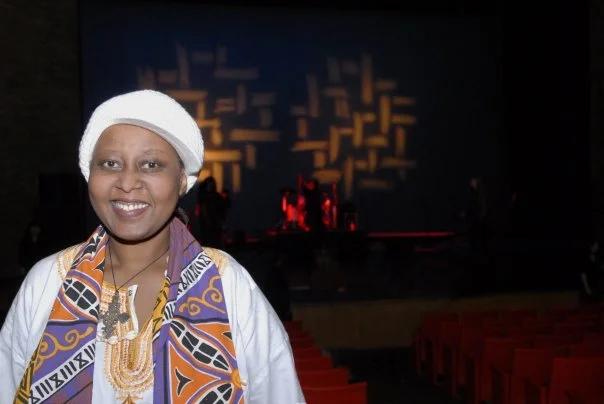
A Kenyan feminist, LGBTQ+ rights activist, filmmaker, and producer, Kagendo Murungi consistently returned to a central question throughout both her work and life: who produces images of African people, who controls their circulation, and who is allowed to appear within them? For Murungi, these were not just abstract concerns but urgent political stakes, inseparable from broader struggles over power, representation, and survival. Though she would ultimately spend much of her life in the United States, Murungi nevertheless operated deliberately across intercontinental cultural, political, and grassroots contexts, building a practice that treated media not only as a site of expression but as a tool for intervention. For over two decades, she tirelessly worked to connect African diasporic storytelling with transnational organizing, insisting that cultural production and political advocacy were not just parallel efforts, but mutually reinforcing ones.
Kagendo Murungi was born in Nairobi, Kenya on December 7, 1971, as one of seven children in a large family, a context that ended up shaping both her early sense of responsibility and her orientation toward collective life. She later moved to the United States, where she would spend the majority of her adult years, pursuing higher education and building a career that moved between academia, media, and community organizing. She first attended Rutgers University, where she earned a bachelor’s degree in women’s studies and became a founding member of a radical, multicultural women-of-color collective, an experience that placed her within a lineage of feminist organizing attentive to race, gender, and global inequality. She later completed a master’s degree in media studies at The New School for Social Research, where her engagement with film and media then became more formally articulated.
Murungi’s early entry into film production began while she was still in school, but it quickly moved beyond the limits of the institution. In 1991, she founded Wapinduzi Productions, a film and media collective that would serve as the central platform for her creative and political work for the next twenty years. The name itself—“Wapinduzi,” meaning “revolutionaries” in Swahili—signaled the orientation of the overarching project: Murungi did not want her work to merely document, she also wanted to intervene in the conditions under which African and diasporic stories were being produced and circulated. Through this platform, Murungi directed and produced numerous documentary films that examined subjects like migration, community, and social change, including Via New York (1995), Sunshine Boutique (2006), and Local Food for Life Ministry (2013). These works often focused on everyday infrastructures—shops, food systems, neighborhood networks—treating them as sites through which broader political and economic dynamics could be understood. In Local Food, for example, Murungi linked Maseru, Lesotho in Southern Africa with East New York in Brooklyn in order to examine food insecurity and access, community-based responses at sites like churches, ministries, and grassroots organizations, and the relationship between local survival strategies and global inequality.
While Murungi’s filmmaking functioned as its own form of advocacy, it also existed alongside her broader, long-standing engagement in political and community-based organizing, which extended beyond the screen. She played a key role in establishing the position of Africa Program Officer at the International Gay and Lesbian Human Rights Commission, helping institutionalize a transnational focus on African LGBTQ+ rights within a global human rights foundation. Her work there, and in subsequent similar roles, reflected a sustained effort to situate sexuality within larger histories of colonialism, migration, state power, and economic inequality. As Kenyan writer and activist Shailja Patel later observed, Murungi was deeply committed to “connecting the dots between all oppressions,” particularly in tracing how colonial legacies had shaped contemporary homophobia across the African continent.
But Murungi’s approach to activism wasn’t limited to formal organizations or a single approach. She worked across a wide range of institutions and grassroots initiatives, including serving as a program associate with the National Black Programming Consortium and collaborating with groups such as Queers for Economic Justice. She was also a long-time volunteer and organizer with the African Film Festival, Inc., where she spent over fifteen years supporting programming and community engagement. In these roles, her work often centered on helping to create the space and conditions under which certain stories could be told and limited resources could be redistributed. This emphasis on infrastructure later extended into her work as director of the food pantry at St. Mary’s Church in Harlem, where questions of food access and economic justice became part of her broader political practice.
Across these different sites and experiences, Murungi consistently treated culture, politics, material conditions, and social relations as inseparable. Just as her filmmaking was not an isolated artistic pursuit, her activism was not limited to just policy or advocacy work. Instead, she moved between each of these domains, judiciously using each to inform the other. Digital media, in particular, held a specific importance for her, not only as a technological tool but as a way to shift authorship. As Murungi once noted, the ability to produce and distribute films online more independently allowed African storytellers to bypass traditional gatekeepers, challenging the structures that had long rendered their stories “controversial or unmarketable.”
Murungi’s work and life were also informed by her diasporic experience. Primarily living and working in New York, she remained engaged with several African and pan-African communities, navigating the complexities of displacement, migration, transnational identity, and community formation. Her projects frequently addressed and interwove these dynamics as lived realities shaped by policy, economics, and cultural expectation. In this sense, Murungi’s output aligned with broader traditions of diasporic cultural production that seek to maintain connection while also responding to the pressures of relocation and adaptation.
Tragically, however, Murungi’s output would be cut short, as she abruptly died on December 27, 2017, at the age of 46, at her home in Harlem. Accounts of her passing emphasize both the suddenness of her death but also highlight the extent of the communities she had built and supported over the course of her life. Is it with the help of these communities, through grassroots organizing and crowdfunding, that she was ultimately buried in Kenya, returning physically to the place from which her work had always remained intellectually and politically connected. In the years since, tributes from colleagues, collaborators, and family members have consistently described her as both “fierce” and “nurturing,” a combination that reflects the dual nature of her practice: uncompromising in its political commitments, but grounded in care and collective responsibility.
Despite the scope of her contributions, Murungi’s work has not been consistently centered within dominant narratives of either film or LGBTQ+ activism. As noted in later efforts to document her legacy, including her inclusion among African women activists underrepresented in public knowledge platforms, her relative absence from widely circulated histories disappointingly reflects broader patterns of omission. The criteria through which figures are deemed “notable”—whether in media, academia, or digital archives—often reproduce existing inequalities, leaving artists and organizers like Murungi insufficiently documented despite decades of sustained work.
Thus to read and consume Kagendo Murungi’s life and work today is not only an act of recovering an overlooked figure in history, but it is also a means to understanding a practice that moved across media, activism, and community organizing. Rather than advancing a single model, Murungi’s work demonstrates how cultural production can function as part of a broader ecosystem of resistance. Remembering Murungi, then, is not a matter of isolating her contributions within a single field, but of recognizing the ways she wove between them, building connections that continue to shape how African stories are told and how communities organize in their wake.
REFERENCES AND FURTHER READING
Disclaimer: some of the sources may contain triggering material
African Film Festival, Inc. (n.d.). Kagendo Murungi Biography. https://africanfilmny.org/directors/kagendo-murungi/
Astraea Lesbian Foundation for Justice. (n.d.). Kagendo Murungi – Grants Panel and Organizational Materials. https://www.astraeafoundation.org
Browning, S. (2005, February 1). This Is A Time To Be Fierce Dreamers! (Interviews with Women Filmmakers). WomenArts. https://www.womenarts.org/2005/02/01/february-2005-interviews/
Kaplan, E. A. (2012). Looking for the Other: Feminism, Film and the Imperial Gaze. Routledge.
Local Food for Life Ministry: Food Justice from Maseru to East New York. (2013). Documentary film. Wapinduzi Productions.
Murungi, K. (2003). Small Axe at the Crossroads: A Reflection on African Sexualities and Human Rights. In M. J. Alexander, L. Albrecht, S. Day, & M. Segrest (Eds.), Sing, Whisper, Shout, Pray!: Feminist Visions for a Just World (pp. 489–501). EdgeWork Books.
Murungi Family. (2018, January). Obituary for Kagendo Murungi.
National Black Programming Consortium. (n.d.). Program and Organizational Records. https://nbpc.tv
OutRight Action International. (2020, November 20). Kagendo Murungi. https://outrightinternational.org
Queers for Economic Justice. (n.d.). Organizational History and Program Materials. https://q4ej.org
Rodriguez, L. (2021, August 9). 7 Notable African Women Activists Who Deserve Wikipedia Pages. Global Citizen. https://www.globalcitizen.org/en/content/african-women-activists-wikipedia/
Scott, J. A. (2024). Home Is Where Your Politics Are: Queer Activism in the U.S. South and South Africa. University of Illinois Press.
Sokari Ekine: Spirit Desire. (2016). Documentary film. Wapinduzi Productions.
Sunshine Boutique. (2006). Documentary film. Wapinduzi Productions.
Via New York. (1995). Documentary film. Wapinduzi Productions.
Wapinduzi Productions. (n.d.). Filmography and Project Materials.