Content notes for torture, sexual violence, suicide
“Home is not land and borders. It’s about people you love.”
– Sarah Hegazi
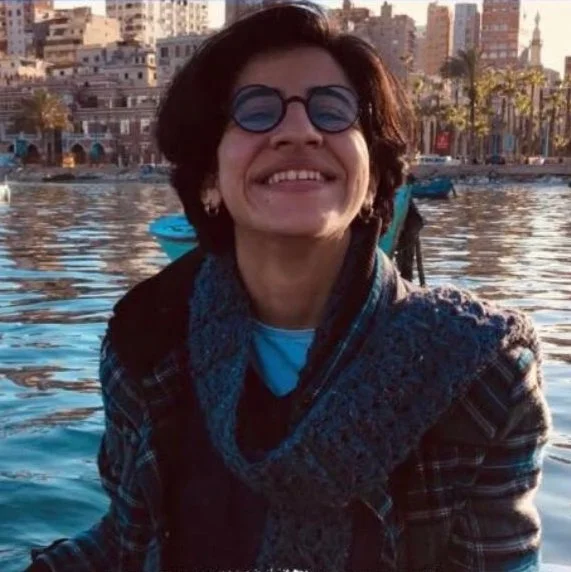
What does it mean to insist on visibility in a place where visibility is criminalized? In 2017, Sarah Hegazi — an Egyptian writer, lesbian feminist, and self-proclaimed socialist — tried to answer this with a single gesture. She lifted a rainbow flag high above a Cairo crowd and, for a brief moment, made queer visibility possible. For that singular act, however, the Egyptian state caged her, segments of society shamed her, and the subsequent trauma of it all shadowed her exile, leading to her untimely and tragic death by suicide at the age of 30. But Hegazi’s short yet powerful life ultimately reflected a broader story — from the unfulfilled hopes of Egypt’s 2011 revolution to a queer grief and solidarity that crosses borders and refuses to be erased.
Sarah Hegazi (also spelled Hegazy or Higazy) was born on October 1st, 1989, in Egypt to a conservative, middle‑class family. As the eldest of four children, she helped her mother raise her younger siblings when her father, a high‑school science teacher, died prematurely. She eventually went on to study information systems and then pursued a career in technology, all the while gravitating toward leftist movements that focused on class-based analyses of repression. She soon began identifying as a communist and started supporting the democratic socialist Bread and Freedom Party in Egypt, of which she eventually became a member. Later on, she would also become involved with the Spring Socialist Network while living in Canada. In 2016, Hegazi came out as a lesbian, which then became a significant part of both her public identity and her activism. Describing herself as “super communist, super gay, and feminist,” she linked her emerging queer visibility to a materialist critique of authoritarianism — what she termed a “battle of class,” in which both the unaccountable state and a guardianship-minded middle class sought to police culture, bodies, and dissent.
On September 22nd, 2017, Hegazi brought her newfound outspokenness into the public eye when she attended a concert in Cairo by Mashrou’ Leila, a Lebanese band whose frontman, Hamed Sinno, is openly gay. Hoisted on a friend’s shoulders, Hegazi lifted a large rainbow flag high into the air–a simple yet bold act and a brightly-hued refusal of compulsory silence. Within days, however, Egyptian television personalities amplified a moral panic, security forces launched raids, and dozens were arrested in what rights groups described as the largest anti‑LGBTQ+ crackdown in years. Hegazi and fellow attendee Ahmed Alaa faced particularly severe charges before the country’s Supreme State Security Prosecution, a political venue normally reserved for handling terrorism cases. Though Egypt at the time no longer criminalized homosexuality by name, decades‑old “debauchery” statutes, broadened after the concert to target online activity, supplied the pretext for policing sexuality and initiating these spectacle trials.
Hegazi was then jailed for the next three months at the Sayeda Zeinab police station. She later described that while in detention there she endured electric shocks, solitary confinement, and sexualized assaults incited by officers. She spoke of how interrogators demanded to know why she had removed her hijab, and about how they would incessantly question whether she was a virgin. Additionally, both at the police station and later at Qanater El Khayereya Women’s Prison where she was held, Hagazi was often kept hidden from sunlight and was forbidden from speaking with other detainees. These alarming accounts detailing her personal experiences, however, echoed broader, well‑documented practices taking place against the LGBTQ+ community in Egypt: entrapment via social networking apps, invasive “examinations,” and prosecutions under nebulous morality codes. After she was released on bail, Hegazi returned to a society where, as she wrote, the “loudest” voices in Egypt — the conservative middle class — had helped legitimize state repression through stigma, shaming, and demands for moral guardianship.
As a direct result, Hegazi sought asylum in Canada in 2018. This new status of external safety, however, did not dissolve the internal harms she had already absorbed. In subsequent interviews and essays, she continued to name her injuries: severe post‑traumatic stress disorder, panic attacks, a new stammer, and episodes of hallucination. She underwent psychiatric care, including electroconvulsive therapy that left her with memory loss. She noted that living in exile seemingly layered fresh trauma and grief atop the old. And, as if the situation weren’t severe enough, Hegazi’s mother died of cancer soon after she left Egypt, and the rules of asylum and the threat of re‑arrest kept her from returning home to mourn. Speaking of this time period, friends in Toronto recalled museum days and symphony nights spent with Hegazi, which included quiet walks in High Park and her acute attentiveness to other people’s pain. “I never felt so alive as during the [2011] revolution,” she told one comrade–a sharp irony, since the collective struggle that energized her was waged against the very forces that would later force her out of Egypt.
After two years of enduring these internal struggles, Sarah Hegazi died by suicide at age thirty in Toronto on June 14th, 2020. Her handwritten note–addressed to siblings, friends, and the world at large–named the cruelties she had endured but also offered forgiveness. Hegazi’s last Instagram post featured a photo of her lying in grass beneath a blue sky, captioned “The sky is more beautiful than earth; I want the sky, not earth,” a phrase which became both elegy and indictment. Hamed Sinno, Mashrou’ Leila’s lead singer, soon set these words to music in a video tribute. Shortly thereafter, vigils bloomed from Beirut, Amman, and Berlin to London, Toronto, and beyond. Murals of Hegazi were painted in Brighton, UK and on Church Street in Toronto’s Gay Village. Organizers also established an annual nonresident fellowship in her name, to support exiled advocates specifically from the Middle East and North Africa region. That year, marchers at Pride events around the world that year also invoked her name as a chant, as both a sign and a promise to fight for those still living without equal rights.
While it is tempting to view Hegazi in her final years as primarily a victim, when she was still alive she very much refused that interpretation. In essays for independent outlets, she boldly examined how authoritarianism intertwines with social conservatism, especially within the middle class. For her, the problem was not only the existence in Egypt of a repressive state; it was the everyday enforcement of patriarchy–at home, in public, and at work–that allowed carceral power to present itself as moral order. Hegazi argued that the Egyptian regime and its Islamist opponents ultimately converged in their policing of gender and sexuality, and that this shared logic underpinned raids, media smear campaigns, and the policing of public culture, from concert stages to chat apps. Her politics were therefore not only about sheer LGBTQ+ visibility, but also about dismantling the systems themselves that decided whose lives matter and whose don’t.
Hegazi also saw her queerness situated within wider geographies of struggle. She linked her fate to Arab uprisings, to Sudanese revolutionaries organizing in Toronto, to Palestinians and Syrians, and to anti‑Black racism in North America. She read Nietzsche with both admiration and critique, often cited the Egyptian feminist writer Nawal El‑Saadawi, and argued that sexuality is not detachable from economy: precarity, debt, and austerity travel through families and can make conformity a condition of survival. She also noted that exile often reproduces violence in a new register, observing that queer and trans Arabs specifically have to navigate homophobia in their “home” states but then face Islamophobia in their newfound “sanctuaries.” Meanwhile, she added, culling from her own experience–asylum systems force people to prove their trauma to officials trained to doubt them, while safety without a community can quickly become an empty category in which one can feel secure on paper but emotionally barren.
Hegazi’s afterlife can also be seen as a strong testament to how the LGBTQ+ community mourns. Scholars and organizers have described the “minor grief” that circulates among queer communities as one without an official language, a wound borne by chosen kin when states and families refuse acknowledgment. In this sense, Hegazi’s legacy stems not only from the moment she raised the flag but also from the network of care that formed after her death: the outpouring of funds, murals, vigils, and essays that treated remembering her as collective work. This communal grief was not only redemptive but also political, and showcased that queer survival depends on real infrastructures like ending carceral practices framed as morality, building asylum systems that understand how trauma affects memory, providing health care and housing that meet refugees’ needs, and creating cultural spaces where LGBTQ+ Arabs are people and not symbols.
Another important lesson to be drawn from the life and death of Hegazi is that queer visibility is not, and should never be, the endpoint. Certainly, Hegazi’s flag raising gesture mattered because it expressed a theory of change–insisting that queer joy in public is a form of dissent. But during her lifetime, Hegazi also cautioned against a politics that stops at representation. She asserted that in Egypt, the post-2011 counterrevolution regained power by merging social conservatism with talk of “national stability,” and by mobilizing the media to target difference. Meanwhile, once she was in exile, she noted that the Western promise of safety proved fragile, unraveling under hostile asylum processes and routine racism. In this context, she argued, real solidarity cannot be just symbolic; it has to be organized, materially resourced, and capable of confronting both state repression and the inequalities of exile.
In the end, Sarah Hegazi deserves to be remembered not as a distant emblem of tragedy but as a rigorous analyst of political power who understood how sexuality, class, patriarchy, and state violence are intertwined. While she became known at first for a single but simple act of visibility, for Hegazi visibility was never the final goal, and she aimed to use it to help other people understand power and teach them about the necessity to care for others. Her legacy thus asks us to do more than just mourn her loss or remember her name and instead work to build the worlds that might have sustained her. Anything less leaves the structures she confronted undisturbed.
REFERENCES AND FURTHER READING
Disclaimer: some of the sources may contain triggering material
Adel, E. (2020, June 19). Sarah Hegazi: Superwoman healing the city. Daraj. https://daraj.media/en/sarah-hegazi-superwoman-healing-the-city/
Amar, P. (Ed.). (202AD). Cairo Securitized: Reconceiving Urban Justice and Social Resilience. American University in Cairo Press.
Arraf, J. (2018, June 18). After crackdown, Egypt’s LGBT community contemplates “dark future.” NPR. https://www.npr.org/2018/06/18/620110576/after-crackdown-egypts-lgbt-community-contemplates-dark-future
Ball, A. (2022). Forced Migration in the Feminist Imagination: Transcultural Movements. Routledge.
Boisvert, N. (2020a, June 17). LGBTQ activist Sarah Hegazi, exiled in Canada after torture in Egypt, dead at 30 | CBC News. CBCnews. https://www.cbc.ca/news/canada/toronto/sarah-hegazi-death
Boisvert, N. (2020b, June 23). “a fighter, a dreamer”: Egyptian LGTBTQ activist Sarah Hegazi remembered with Love at funeral | CBC news. CBCnews. https://www.cbc.ca/news/canada/toronto/sarah-hegazi-funeral
Camminga, B., & Marnell, J. (2022). Queer and Trans African Mobilities: Migration, Asylum and Diaspora. Bloomsbury Publishing.
Cheaito, H. (2025, June 13). The nameless grief we share: Remembering Sarah Hegazi. The Tahrir Institute for Middle East Policy. https://timep.org/2025/06/13/the-nameless-grief-we-share-remembering-sarah-hegazi/
Davies Hayon, K., & Van de Peer, S. (Eds.). (2024). Transnational arab stardom: Glamour, performance and politics. Bloomsbury Publishing.
El Sirgany, S. (2020, June 17). How One gay Egyptian woman stood up to homophobia and paid the ultimate price. CNN. https://www.cnn.com/2020/06/17/middleeast/sarah-hegazi-egypt-intl
Finden, A. E. (2025). Counterterrorism and colonialism: Everyday violence in Britain and Egypt. Routledge.
Fouad, M. (2021, June 28). Is it already a year?!. The Tahrir Institute for Middle East Policy. https://timep.org/2021/06/28/is-it-already-a-year/.
Hage, R. (2020, July 14). The sky and not the Earth: In honor of Sarah Hegazi (1989-2020). Los Angeles Review of Books. https://lareviewofbooks.org/short-takes/sky-not-earth-honor-sarah-hegazi-1989-2020/
Hegazi, S., Ghoneim, O., & Gad, M. A. (2021, June 1). Opinion: A year on, Sarah Hegazi’s death must not go unmarked. OPENLY. https://www.openlynews.com/i/?id=e10cc6b7-4f30-4c2d-9fdb-d06f709df8f9
Imran, Y. S. (2020, June 19). Arab LGBT community mourns the loss of Sara Hegazy. The New Arab. https://english.alaraby.co.uk/english/indepth/2020/6/19/arab-lgbt-community-mourns-the-loss-of-sara
Keeshig-Tobias, K., & Al Soufi, A. (2021, June 30). Remembering Sarah Hegazi, one year on. Spring. https://springmag.ca/remembering-sarah-hegazi-one-year-on
Knipp, K., & Mellouk, I. (2020, June 16). Egyptian LGBT+ activist dies at 30. dw.com. https://www.dw.com/en/egyptian-lgbt-activist-sarah-hegazy-jailed-for-waving-rainbow-flag-dies-at-30/a-53831469
Lannon, V. (2020, June 15). Our tribute to comrade/rafeqa Sarah Hegazi. Spring. https://springmag.ca/our-tribute-to-comrade-rafeqa-sarah-hegazi
Papazian, H. (2020, July 16). She waved a rainbow flag at our cairo show. Tragedy followed. The New York Times. https://www.nytimes.com/2020/07/16/opinion/culture/mashrou-leila-fan-suicide.html
Plant, M. (2020, June 16). Mashrou Leila frontman Sings moving tribute to gay activist. The New Arab. https://www.newarab.com/news/mashrou-leila-frontman-sings-moving-tribute-gay-activist
Qais Munhazim, A. (2020, July 10). Suicide of Egyptian activist Sarah Hegazi exposes the “freedom and violence” of LGBTQ Muslims in exile. The Conversation. https://theconversation.com/suicide-of-egyptian-activist-sarah-hegazi-exposes-the-freedom-and-violence-of-lgbtq-muslims-in-exile-141268
Sorbera, L. (2025). Biography of a Revolution: The Feminist Eoots of Human Rights in Egypt. University of California Press.
Vogeding, C. (2022, May 13). Sarah Hegazi & Hamed Sinno: The Queer Solidarities, Alliances, and Tragedies in the Making of Regional Icons. Storymaps. https://storymaps.arcgis.com/stories/
Walsh, D. (2020, June 15). Arrested for Waving Rainbow Flag, a Gay Egyptian Takes Her Life. The New York Times. https://www.nytimes.com/2020/06/15/world/middleeast/egypt-gay-suicide-sarah-hegazi.html
Younes, R. (2022, September 28). For Sarah Hegazy: In rage, in grief, in exhaustion. Human Rights Watch. https://www.hrw.org/news/2020/06/16/sarah-hegazy-rage-grief-exhaustion.