“I'm also not sure exactly where and when I got the language for who and what I am. I don't remember how I learned the words gay, homo(sexual), fag, queer, etc. I just seemed to have picked them up and understood what they meant.
– Justin Chin
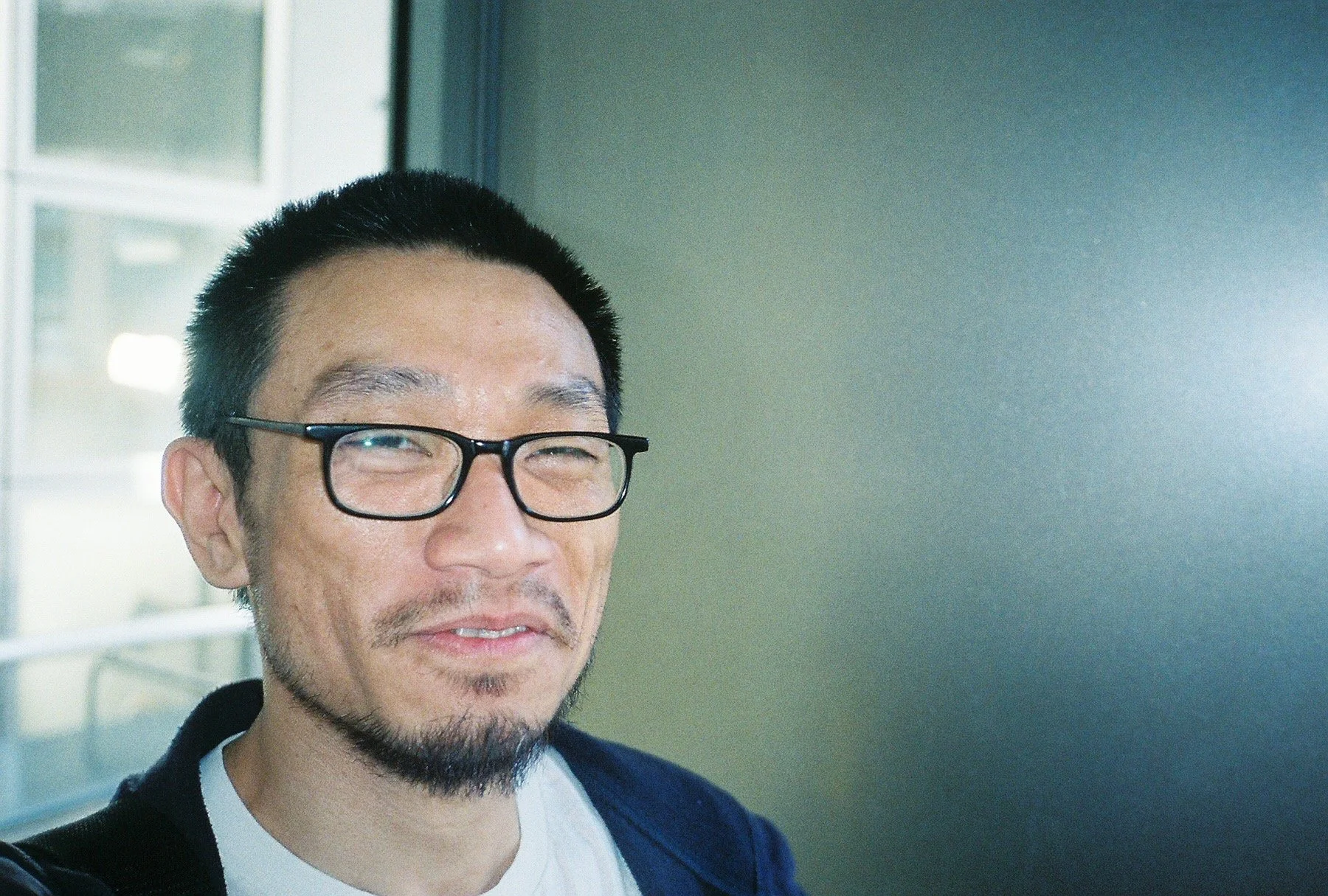
Born in 1969 in Malaysia and raised in Singapore, Justin Chin came of age before establishing himself in San Francisco in the 1990s as a poet, essayist, and performer. Over the course of his career — cut short in 2015 following a stroke linked to complications from AIDS — he developed a body of work that persistently examined how the languages surrounding sexuality, race, and identity are produced and circulated through culture. These vocabularies, rather than emerging organically, appear in his writing as learned systems that are absorbed, repeated, and often imposed in ways that obscure their underlying power. Chin’s work also resists treating identity as stable or coherent; instead, it presents it as unevenly acquired and structurally constrained, frequently at odds with lived experience. Across his poetry, essays, and hybrid prose — both published and performed — he refused both simplification and the pressures of respectability that often shape how minority subjects are expected to appear.
Justin Chin’s early life unfolded across both national and cultural borders. After being born in Malaysia to Christian parents with high expectations, he was raised in Singapore and then moved to the United States for higher education. He first attended the University of Hawaiʻi at Mānoa, where, in an introductory creative writing course, he began to take poetry seriously as both a craft and a vocation. Poet and visual artist Faye Kicknosway taught this class, and she became both an influential figure in Chin’s early career and introduced him to several other notable Asian American writers including Lisa Asagi and R. Zamora Linmark. With economic support, Chin then attended the very first Outwrite Conference in San Francisco in 1990 — a landmark annual conference that offered lectures and workshops for LGBTQ+ writers — which would also prove highly influential to him.
Indeed, one year later Chin would relocate to San Francisco, enrolling at San Francisco State University to join their journalism program. This move proved decisive, as San Francisco in the early 1990s was a city shaped by overlapping forces: the aftershocks of the AIDS crisis, the vibrancy of queer performance culture, and a spoken-word movement that emphasized immediacy and embodiment. Within this environment, Chin was able to both find and form a literary community that valued the combination of political urgency and aesthetic experimentation.
In fact, Chin first came to prominence through his performances. He became a member of the San Francisco National Poetry Slam team in 1995 and 1996, participating in a movement that blurred the boundaries between page poetry and staged delivery. Spoken-word performance in particular suited Chin’s style, as his readings combined humor, confrontation, and narrative vulnerability and allowed him to address racism, homophobia, fetishization, and diasporic alienation with both theatrical timing and lyrical precision. His brash presence on stage also helped reinforce what many of his texts already suggested — that poetry was not simply an object to be read silently, but a social act capable of unsettling audiences.
Chin’s first poetry collection, Bite Hard, was published in 1997 and announced this sensibility in sustained form. The collection foregrounded desire and anger in equal measure, refusing the sanitized narratives often imposed on queer Asian subjects. Chin’s poems here exposed the ways Asian men were racialized as passive or exotic, the ways queer communities reproduce racial hierarchies, and the ways that intimacy can both console and wound. In “A History of Geography,” for example, he wrote:
“I let them take me,
do what they want with me
even if it hurts me bad/ makes me bleed/ makes me bruise/ sore/ &
sad/ satisfied/ & happy/ mad/ desolate,
let them do what they want with a slab of meat
because they’re giving me a place I cannot get to.”
Subsequent collections published by Chin, including Harmless Medicine (2001) and Gutted (2006), continued to expand on these themes and concerns. Gutted in particular would become one of his most celebrated works. In 2007, it received the Thom Gunn Award for Gay Poetry from the Publishing Triangle and it was also a Lambda Literary Award finalist. These accolades boosted Chin’s recognition within broader queer literary circles all the while cementing his position within contemporary American poetry.
Chin’s published literary output also extended well beyond poetry. His semi-autobiographical prose works — including Mongrel: Essays, Diatribes, + Pranks (1998), Burden of Ashes (2002), and Attack of the Man-Eating Lotus Blossoms (2005) — combined memoir, cultural critique, and satire. Altogether, these texts challenged the expectation that writers of color should produce legible cultural testimony. Chin instead embraced fragmentation, contradiction, and tonal shifts, presenting the self as unstable and shaped by competing pressures. His later fiction collection, 98 Wounds (2011), further demonstrated his range in this capacity, exploring narrative forms while maintaining his characteristic thematic intensity. In addition to these numerous published works, Chin also had a significant body of unpublished materials, including several full-length and shorter performance pieces.
Regardless of the medium, though, Chin persistently returned throughout his work to the politics of visibility. To claim a queer Asian American identity, his writing suggested, was never a neutral act. It would always be mediated by audience expectation and cultural hierarchy. His poetry frequently staged encounters in which desire was racialized and commodified, exposing how personal attraction can replicate broader systems of power. But Chin also resisted collapsing his work into straightforward polemics, embedding humor, irony, and self-scrutiny alongside critique and preventing his writing from becoming too didactic. This resulted in a body of work that critiqued systems of oppression while also acknowledging the complexities of participating in them.
Alongside his literary output, Chin was also deeply embedded in the literary community. He taught workshops, participated in readings, and mentored emerging writers. His vibrant presence in San Francisco’s literary landscape was thus marked not only by his publications but also by his collaborative spirit, and writers who worked alongside him frequently recalled his incisive commentary and his commitment to fostering difficult but necessary conversations about race and sexuality within queer spaces. This collective aspect of his career highlights that Chin’s work was inseparable from the communities and networks that sustained and amplified it.
Though Chin had been highly prolific, on December 19th of 2015 he suffered a massive stroke while at home in San Francisco. He was subsequently rushed to the California Pacific Medical Center, but would tragically die five days later on December 24th at the age of 46. His untimely and sudden death prompted an outpouring of tributes from poets, scholars, and performers who recognized the singularity of his voice. Kirk Read, a fellow San Francisco writer and friend of Chin’s wrote: “Justin spent a lifetime managing complexity…He was at once socially awkward and a vivid public presence. His writing voice could be catty and profound, intimate and mythic, explicit and restrained.” Similarly, writer Beth Lisick wrote: “Justin is my Kathy Acker, my John Waters, my Sandra Bernhard. A person so sharp and transgressive that he can be scary or intimidating, except the way he embraces his own sensitivity also allows him to be cuddly and sweet and so incredibly funny.” Many folks at the time quoted or shared lines written by Chin himself in his poem “Grave,” his own ruminations on life and death:
“I used to have this theory about how
much life a human body could hold.
It all had to do with the number
of heartbeats. Each human is assigned a number
determined by an unknown power cascading
over the dark waters of the unformed Earth.
For some, it was a magnificently high number,
seen only in Richie Rich comics, and for others,
it was frightfully low, like twenty-six.
No bargaining, no coupons,
no White Flower Day sale, no specials. Once
you hit your number, you croak.”
Since his passing, posthumous collections including Justin Chin: Selected Works have helped preserve and curate Chin’s writing for new audiences. These new editions also highlight the continued relevance of his themes, including racialized desire, queer belonging, illness, grief, and the instability of identity categories. Indeed, more than a decade after his death, Justin Chin’s work continues to resist easy placement within queer and Asian American literary histories. His writing does not resolve the conditions it critiques; it makes them visible, and in doing so, leaves them open for continued confrontation. Reading Justin Chin today is not simply an act of recovery, but an engagement with a body of writing that keeps its central tensions–between visibility and marginalization, desire and racialization, performance and self-definition–deliberately unresolved. Rather than offering coherence, his work sustains these contradictions, exposing the limits of the categories used to organize identity and experience. Remembering Chin, then, is not about securing his place within a canon or smoothing his work into legibility, but about remaining attentive to the friction he maintained.
REFERENCES AND FURTHER READING
Disclaimer: some of the sources may contain triggering material
Brownworth, V. (2015, December 29). In Remembrance: Justin Chin. Lambda Literary Review. https://lambdaliteraryreview.org/2015/12/in-remembrance-justin-chin
Chen, C. (2023, September 18). On Being A “Serious” Poet. The Poetry Foundation. https://www.poetryfoundation.org/featured-blogger/85734/on-being-a-serious-poet
Chen, K. (2016, January 11). Remembering Justin Chin. Hyphen - Asian America Unabridged. https://hyphenmagazine.com/blog/2016/01/remembering-justin-chin
Chin, J. (1997). Bite Hard. Manic D Press, Inc.
Chin, J. (1998). Mongrel: Essays, Diatribes + Pranks. St. Martin’s Griffin.
Chin, J. (2001). Harmless Medicine. Manic D Press, Inc.
Chin, J. (2006). Gutted. Manic D Press, Inc.
Chin, J. (2011). 98 Wounds. Manic D Press, Inc.
Chin, J. (2016). Justin Chin: Selected Works (J. Joseph, Ed.). Manic D Press, Inc.
Chin, J., & Chee, A. (2022). Burden of Ashes. Manic D Press, Inc.
Eng, C. A. (2020). Apprehending the “Angry Ethnic Fag.” GLQ: A Journal of Lesbian and Gay Studies, 26(1), 103–128. https://doi.org/10.1215/10642684-7929125
Jones, K. L. (2015, December 23). Report: San Francisco Poet Justin Chin Dies. KQED. https://www.kqed.org/arts/11184834/justin-chin-san-francisco-poet-off-life-support-after-stroke
McMurtrie, J. (2015, December 24). Justin Chin, S.F. Poet who Incorporated Complex Themes, Dies. SFGate. https://www.sfgate.com/books/article/San-Francisco-poet-Justin-Chin-dies-at-46-6719862.php
Murray, S. O. (2003). Representations of Desires in Some Recent Gay Asian-American Writings. Journal of Homosexuality, 45(1), 111–142. https://doi.org/10.1300/j082v45n01_06