“All, all died…because of my genderlessness, which nevertheless contains every gender.”
– Anita Berber
Though she is more often remembered for the scandals she caused than for her artistry, Anita Berber was nevertheless one of the most daring and innovative performers to emerge from Germany during the early twentieth century. A dancer, choreographer, silent film actress, fashion model, poet, cabaret artist and muse, she used her body and public image to challenge conventional ideas surrounding gender, sexuality, female respectability, and artistic expression. Her dances explored taboo and scandalous subjects like addiction, lust, pregnancy, madness, suicide, disease, and death, while her cropped red hair, exaggerated makeup, tailored suits, ties, and monocles helped shape the androgynous image of the Weimar Republic’s “New Woman.” Openly involved with both women and men, Berber also became a visible presence within Berlin’s gay and lesbian circles, folding her queer personal life into the provocative persona she presented onstage. At a time when women’s bodies were generally displayed for male pleasure, she instead made her own an erotic but often disturbing medium through which audiences were forced to confront subjects they might otherwise avoid. Yet, despite the abundance of media and publications devoted to Berber, a historically reliable account of her life remains difficult to reconstruct. Newspapers at the time eagerly sensationalized her arrests, addictions, sexual affairs, and theatrical disputes, while Berber herself understood that notoriety sold tickets and deliberately blurred the boundary between her stage persona and private life. Meanwhile, after her death, fictionalized biographies and popular histories further embellished her exploits, turning her into an almost mythical symbol of Weimar decadence. More recent scholars, however, have attempted to look beyond that mythology to reexamine and reclaim Berber as a serious cultural producer and an early and important performance artist who consciously transformed her body, sexuality, and celebrity status into interconnected forms of creative expression.
Anita Berber was born on June 10th, 1899, in Leipzig, Germany. Her father, Felix Berber, was an accomplished concert violinist who later taught at Munich’s Academy of Music, while her mother, Lucie Anna Thiem, was a cabaret performer and chanson singer in Berlin. The couple divorced in 1902, and in 1906 Anita moved into the Dresden home of her maternal grandmother, Luise Thiem, where she was raised alongside three of her aunts. Berber attended a municipal school for middle- and upper-class girls in Dresden until 1913 and then briefly enrolled at Curt Weiss’ boarding school in Weimar the following year. Then, during the winter of 1914–1915, as the First World War transformed everyday life throughout Germany, Berber relocated to the Berlin neighborhood of Wilmersdorf, where she lived with her mother, grandmother, and aunts. Though Berber’s later biographers often interpreted her parents’ separation and frequently disrupted upbringing as explanations for her eventual rebellious behavior, the artistic careers pursued by both her parents also seem to have instilled in her an early understanding that performance could become a means to building an identity beyond the restrictions of ordinary bourgeois life.
In 1915, sixteen-year-old Berber began studying acting with Maria Moissi and enrolled in the dance studio of Rita Sacchetto, a pioneering performer associated with the emerging movement of German Expressionist dance. Sacchetto was known for creating “dance pictures” that combined theatrical movement with poses inspired by paintings, sculptures, and other visual art. Rather than relying exclusively upon the rigid vocabulary of classical ballet, Sacchetto encouraged her pupils to develop individual characters and communicate emotional or psychological states through their bodies. Berber soon joined Sacchetto’s touring company, appearing with the troupe throughout Germany between 1916 and 1918. She gave an early performance at Berlin’s Blüthner-Saal in 1916 and, after separating from Sacchetto the following year, began to appear independently at prominent venues like the Apollo-Theater and Wintergarten. By 1917–1918, while still only eighteen years old, Berber was already presenting her own solo dance recitals and touring internationally through Switzerland, Austria, and Hungary.
Though Berber’s later reputation would largely rest upon eroticism and scandal, reviews of these first performances recognized her as a promising modern dancer. Her early repertoire drew on stylized character pieces and the Expressionist desire to transform internal emotions into visible physical movement. One 1917 review described her as both daring and remote from conventional sweetness, but also noted that she came off as “always a little boyish”—an observation that would foreshadow the gender ambiguity Berber later cultivated more intentionally. But even at this early career stage, critics were struck by Berber’s technical virtuosity, as well as by her sharply controlled gestures, angular body, extraordinary intensity, and ability to transform herself into a sequence of distinct and sometimes unsettling characters. They astutely noted that she did not seek to disappear into a role so much as to use each role to reveal another possible version of Anita Berber.
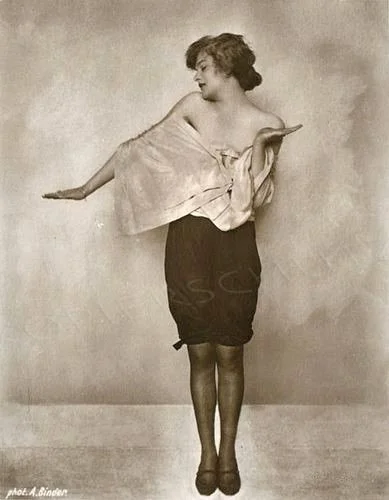
In addition to dancing, Berber also began to work as a fashion and hat model around this time. Beginning in 1917, photographs of her appeared in prominent publications including Die Dame, Elegante Welt, and the German edition of Vanity Fair. She modeled costumes and theatrical clothing for Hugo Baruch & Company and appeared at fashionable costume balls, gradually turning herself into a recognizable presence within Berlin’s rapidly expanding economy of celebrity images. Notably, Berber adopted an increasingly androgynous wardrobe, appearing in men’s hats, smoking jackets, neckties, and monocles, while simultaneously maintaining a dramatically feminine face covered in pale foundation, darkened eyes, and sharply painted lips. Her look became known as “à la Berber” and was reportedly imitated by other performers, including a young Marlene Dietrich. Berber seemed to understand that photography could multiply the versions of herself circulating through public life, and she thus posed as a glamorous woman, a slender boy, a femme fatale, an exotic dancer, and a modern urban sophisticate, never settling permanently into one recognizable gendered role or allowing fashion photographers to define her image.
Berber’s circulating images soon began to attract more established visual artists. In 1919, Charlotte Berend-Corinth created a portfolio of eight lithographs showing Berber in a variety of poses, some fully clothed and others nude except for stockings or jewelry. Around the same time, artist Lotte Pritzel produced both a drawing and a wax figure inspired by her, while Constantin Holzer-Defanti used Berber as a model for his porcelain dancer sculptures. Among others, these works demonstrate that Berber’s body had quickly become more than just a vehicle through which she performed choreography; it had also turned into an artistic subject that painters, photographers, sculptors, and designers wanted to repeatedly interpret and reproduce.
But dance and the visual arts were not the only fields in which Berber experienced an early rise. Between 1918 and 1925, she appeared in roughly two dozen silent films, many directed by the socially provocative Austrian filmmaker Richard Oswald. Berber’s first screen roles included appearances in Das Dreimäderlhaus, Dida Ibsens Geschichte, and Around the World in Eighty Days, in which she played Aouda and performed several dances. She subsequently portrayed the roles of prostitute, circus performer, anarchist, dancer, lover, or femme fatale in films like Unheimliche Geschichten, Nachtgestalten, The Golden Plague, Lucrezia Borgia, and Die vom Zirkus. She also performed as a dance double in Fritz Lang’s Dr. Mabuse the Gambler. Though few of these films granted her the kind of creative authority she possessed onstage, they nevertheless amplified her recognizability and allowed her stylized gestures and unusual appearance to reach audiences well beyond Berlin.
Particularly noteworthy was Berber’s involvement in two of Oswald’s 1919 “enlightenment films”: Die Prostitution and Anders als die Andern (Different from the Others). Produced in collaboration with the pioneering gay Jewish sexologist Magnus Hirschfeld, Different from the Others explicitly condemned Paragraph 175, the law criminalizing sexual relations between men, and is generally regarded as one of the earliest films to present homosexuality sympathetically. In the film, Berber played Else, the sister of a gay violin student, rather than an explicitly queer character herself, but her participation in it nevertheless connected her to one of the most radical sexual-reform films of the period. The film was a popular success before being attacked by conservative groups and becoming effectively prohibited after the reintroduction of German film censorship in 1920. Berber thus entered cinema at precisely a moment when sexual science, queer activism, mass entertainment, and political censorship were intersecting with one another in unprecedented ways.
In 1919, Berber married Eberhard Engelhard von Nathusius, a former military officer who later worked as an antiquarian bookseller. The union, however, produced no children and ended in divorce on January 10th, 1922. During the marriage, though, Berber became romantically involved with the actress Susi Wanowski—born Hanna Busch—who later helped manage her career. Wanowski was a prominent figure within Berlin’s lesbian community and owned two bars catering to women. According to the chronology maintained by the German Dance Archive, Berber left Nathusius and moved in with Wanowski in 1922. This documented cohabitation is one of the clearest surviving indications that Berber was not simply surrounded by queer people or occasionally rumored to have same-sex affairs, but that she actively participated in lesbian social life and maintained a significant relationship with another woman.
In 1920, Berber appeared at Max Reinhardt’s political and literary cabaret Schall und Rauch and also performed with Celly de Rheidt’s controversial nude ballet. With stage censorship weakened after the First World War, nude dance, or Nackttanz, became an increasingly visible part of German entertainment and body culture. Some performers presented nudity as an expression of health, naturalism, or classical beauty, but Berber used it to depict addiction, decay, sexual compulsion, and death. Her thinness, mask-like makeup, sharply controlled poses, and sometimes violent gestures opposed the ideal of the innocent, “natural” nude. Although the press soon made Berber virtually synonymous with dancing naked, historian Christian Haider has demonstrated that contemporary reporting frequently exaggerated how often she actually appeared fully nude.
Regardless, this erotic turn made Berber a star, but it also harmed her ambition to be taken seriously within the more prestigious world of Expressionist dance. Respectable critics who had once praised her emotional precision increasingly dismissed her as a nightclub attraction, while newspapers presented her personal behavior as inseparable from her art. Berber, meanwhile, incorporated the controversies ever more deliberately into her performances. She constructed dances around figures like Salome and Astarte and devised works in which the female body conveyed lust, cruelty, illness, and self-destruction. In some pieces, Berber appeared to stage experiences that women were rarely permitted to represent from their own perspectives, including sexual pleasure, menstruation, pregnancy, and masturbation. While such works could certainly be consumed voyeuristically, they also destabilized the convention that female nudity existed only for uncomplicated male pleasure.
Berber’s most important creative partnership, however, began in 1922 with the poet, dancer, and visual artist Sebastian Droste. Thin, dark-haired, and openly associated with Berlin’s homosexual artistic circles, Droste shared Berber’s interest in Expressionism, decadence, bodily extremity, and death. Though many later accounts refer to Droste as Berber’s “second husband”, there is no documented evidence of theirs being a legal marriage, and it is therefore safer to describe Droste as Berber’s intimate and artistic partner. Whatever their precise legal status, the two developed an intensely collaborative body of work in which Berber generally supplied much of the choreography and physical interpretation while Droste contributed poems, concepts, staging ideas, and visual designs.
Perhaps most famously, Berber and Droste co-created Die Tänze des Lasters, des Grauens und der Ekstase—Dances of Vice, Horror and Ecstasy—which they performed in Berlin and then during a prolonged engagement in Vienna between late 1922 and early 1923. The program included dances with titles like Cocaine, Morphium, and Suicide, treating addiction and death as embodied psychological experiences. In Cocaine, set in part to Camille Saint-Saëns’ Danse macabre, Berber transformed the drug’s progression through the body into movement. In other pieces, the couple performed as spectral, puppet-like, or sexually ambiguous beings whose gestures seemed to hover between desire and collapse. Collectively, their characters were not meant to be conventionally beautiful; they trembled, contorted, hardened, weakened, and surrendered themselves to forces that appeared simultaneously pleasurable and deadly.
Berber and Droste then expanded the project beyond live dance. In 1923, they published a lavish book bearing the program’s title, which contained Expressionist poems, photographic tableaux, costume and set designs, drawings, and essays. Droste contributed twenty-six poems and Berber four, while photographs taken in Vienna by the celebrated photographer Madame d’Ora transformed poses from the dances into carefully composed standalone images. A short film was also produced, making Dances of Vice, Horror and Ecstasy an unusually ambitious work that spanned dance, poetry, photography, design, and cinema. Scholar Katharina Herold-Zanker argues that this intermediality was more fundamental to the project’s decadence than simple nudity. Rather than just creating a dance that would all but disappear once the performers left the stage, Berber and Droste constructed a network of images and texts through which the performance could continue to circulate and live on.
Berber’s poetry in the book also complicated any simple understanding of her gender or sexual identity. In “Orchids,” for example, she described lovers dying because of her Geschlechtslosigkeit, a German word that can suggest sexlessness, genderlessness, or the absence of a fixed sex, even as she claimed that this state contained every gender within it. It would, however, be anachronistic to assign Berber a contemporary nonbinary identity on the basis of a single poem, particularly when she left behind no sustained autobiographical explanation of her gender. Nevertheless, the language in said poem indicates that Berber’s self-conception may have involved more than bisexual desire alone. Her masculine clothing, feminine makeup, male and female lovers, and frequent portrayal of beings who crossed or evaded gender boundaries collectively suggest that gender ambiguity itself was central to her artistic identity. Rather than choosing between masculinity and femininity, she repeatedly claimed both and allowed neither to contain her.
The seriousness with which Berber approached her work, however, was frequently lost on her spectators. In one surviving letter, she protested that her performances addressed complex topics like death, illness, and pregnancy, but audiences remained preoccupied with looking beneath the dancers’ veils. This conflict became especially apparent in Vienna. Between November 1922 and January 1923, Berber and Droste performed at venues including the Konzerthaus, Kammerspiele, Apollo-Theater, and the nightclub Tabarin. Austrian newspapers covered Berber obsessively, but often as a symbol of social collapse rather than as an artist. Haider’s analysis of twenty-three different Austrian newspapers from the time demonstrates how journalists constructed her as a metaphor for postwar inflation, prostitution, criminality, and urban moral disorder. The press label “dancing sin” became specifically attached to her, encouraging readers to perceive Berber less as an individual performer than as the physical embodiment of everything they feared about the era.
Berber and Droste also fueled the uproar by breaking theatrical contracts and clashing with managers and authorities. In January of 1923, they were expelled from Austria and sent to Hungary. They subsequently performed in Budapest and toured through Italy and Yugoslavia, at one point appearing alongside the clairvoyant Frederik Marion. Their collaboration, however, soon disintegrated when Droste returned to Berlin, took Berber’s jewelry, and then departed for New York. By then, both were struggling with cocaine addiction, and the grand multimedia ambitions of Dances of Vice, Horror and Ecstasy had failed to produce financial stability. Despite this, the project would survive as Berber’s most important artistic achievement and as evidence that she was far more than the passive object of the scandals that surrounded her.
Berber herself then returned to Berlin and its cabarets and soon formed her own troupe. In 1924, she met the American dancer Henri Châtin-Hofmann, born Heinrich Victor Agricola Hofmann in Baltimore, the son of a Protestant minister. They married in Berlin on September 10th, 1924, and began performing together at venues including Die Rakete, Die Weisse Maus, and Die Rampe. Over the next two years, the couple toured through countless cities including Cologne, Düsseldorf, Wiesbaden, Leipzig, Breslau, Dresden, Hamburg, Stockholm, Prague, and Amsterdam. They developed new programs, including Dances of Eroticism and Ecstasy, and continued to rely on Berber’s reputation for danger and erotic transgression in order to attract audiences. Though her fame had begun to decline, she remained enough of a draw that her arrival in a city would still generate buzz—a mix of anticipation, gossip, and sometimes police attention—before she had even reached the stage.
Berber’s dances with Châtin-Hofmann still continued to test the boundaries between erotic display and representations of female autonomy, though her work now more explicitly incorporated gestures of sexual pleasure, physical degradation, and bodily harm. Police and moral authorities would thus scrutinize her performances, and Berber repeatedly became involved in arguments, arrests, and public disturbances. In 1926, for example, Berber and Henri Châtin-Hofmann became involved in a widely reported altercation at Prague’s Sect Pavillon before presenting Dances of Eroticism and Ecstasy at Hamburg’s Alkazar. Later that summer, Berber was imprisoned for several weeks in Zagreb after publicly insulting King Alexander I. Each incident further ensured that discussions of Berber’s behavior overshadowed the actual content of her choreography, while also making her one of the few women of the era whose refusal to be respectable became an internationally recognizable form of celebrity.
It was during Berber’s tours with Châtin-Hofmann that she met the German artist Otto Dix, who would paint his famous Portrait of the Dancer Anita Berber in Düsseldorf in 1925. Dix depicted her almost entirely in red: cropped red hair, a long and tightly fitted red dress, and a dark red background that seemed to blend with and absorb her body. Her face, meanwhile, is covered in thick white makeup, while her eyes and mouth appear sharply painted and porcelain-like. One hand extends forward with claw-like fingers as Berber turns her gaze away from the viewer. The painting has often been interpreted as an image of a prematurely aged and physically deteriorating woman, but art historian Anne Reimers argues that it also addresses Berber’s status as a modern celebrity whose image had already been heavily reproduced through film, fashion, and photography. Dix did not intend to simply record Berber’s appearance; he aimed to condense the many existing versions of her—the dancer, fashion figure, addict, femme fatale, and declining star—into a single unnervingly fixed image.
The painting eventually became more famous than almost any dance Berber created. When it was first exhibited in Berlin in 1926, however, it was rejected as offensive by the jury of an exhibition at the Crown Prince’s Palace. The Kunsthalle Nürnberg later acquired it, only for the Nazis to confiscate it and deem it “degenerate” art. Its whereabouts then became uncertain before Dix himself reacquired it during the postwar period. Today, the portrait belongs to the Landesbank Baden-Württemberg collection and is held on long-term loan at the Kunstmuseum Stuttgart. It has become such a recognizable image of the Weimar era that Berber’s painted likeness now seems more historically tangible than the moving body upon which her career depended. Since dance disappears as it is performed, Dix’s portrait—along with photographs and fragments of film—has played an outsized role in determining how subsequent generations imagine Anita Berber.
By 1927, Berber’s opportunities in Germany had significantly diminished. Her alcoholism and cocaine use had damaged her health and professional relationships, and many venues were reluctant to employ her. She and Châtin-Hofmann consequently embarked upon an extended tour through southern Europe and the Middle East, performing in Athens, Cairo, Alexandria, Beirut, Baghdad, and Damascus. On July 13th, 1928, though, Berber collapsed during a performance in Damascus and was swiftly diagnosed with tuberculosis. The couple then made the difficult journey back to Berlin, where Berber initially stayed in her mother’s apartment before being admitted to Bethanien Hospital. She died there on November 10th, 1928, exactly five months after her twenty-ninth birthday. Four days later, she was buried at the cemetery of the St. Thomas parish in Berlin-Neukölln. Her grave, however, was removed during the late 1950s and no longer survives.
Berber’s untimely passing only accelerated the transformation of her life into that of a legend. In 1929, for example, Leo Lania published Der Tanz ins Dunkel, a purported biographical novel that helped preserve her name while fictionalizing many details. Czech choreographer Joe Jenčík produced a more serious study of her dances the following year, but Berber’s actual choreography otherwise gradually slipped out of cultural memory. Berber left no complete personal archive through which her works could be authoritatively reconstructed, and the ensuing rise of Nazism further erased the queer, sexually experimental, and artistically radical culture in which she had flourished. As a result, for a long time Berber was remembered primarily through scandalous anecdotes, nude photographs, and the Otto Dix portrait rather than as the creator of a substantial and carefully constructed body of performance work.
A meaningful recovery of Berber’s story, though, began during the 1980s, largely through the work of biographer and curator Lothar Fischer. In 1984, Fischer organized the first major Anita Berber exhibition, Tanz zwischen Rausch und Tod, at Berlin’s Haus am Lützowplatz and published a book containing photographs, posters, documents, and testimony from people who had known her. Rosa von Praunheim’s film Anita: Dances of Vice followed in 1987, and in 1988 the organization that became Berlin’s Schwules Museum mounted another exhibition focused on Berber’s career, queer relationships, and place within Berlin nightlife. Even more public commemorative acts arrived decades later. A memorial plaque was installed at her former Wilmersdorf home at Zähringerstrasse 13 in 2003, and the site of her former grave’s cemetery was named Anita-Berber-Park in 2017. More recent scholarship and exhibitions—including the 2023 Photoinstitut Bonartes exhibition in Vienna and the Kunstmuseum Stuttgart’s 2025 presentation Anita Berber: “Orchids”—have continued to try and separate her artistic contributions from the sensational mythology surrounding them.
Anita Berber was therefore not just a casualty or emblem of Weimar excess. She was an audacious artist who recognized that the body could become a battleground upon which society’s anxieties about women, queerness, sex, drugs, disease, and modernity could be made visible. Though the scandals attached to her name certainly contributed to her fame and decline, they should not be permitted to obscure the seriousness of what she attempted via her artistry. Through dance, fashion, film, photography, poetry, and her own deliberately performed identity, Berber created new possibilities for representing bodies and desires that refused to remain private, respectable, or easily understood. Her historical LGBTQ+ significance can be seen across numerous dimensions of her life and work: her relationship with Susi Wanowski connected her directly to Berlin’s lesbian community; her collaborations with gay artists placed queer creative partnership at the center of her most ambitious projects; and her poetry imagined a state beyond fixed gender that nevertheless encompassed all genders at once. Nearly a century after her death, her life and surviving work continue to challenge the boundaries between masculinity and femininity, erotic object and creative subject, personal behavior and public art. She did not merely dance the vice, horror, and ecstasy of her era; she forced her audiences to confront the unsettling possibility that all three already existed within them.
REFERENCES AND FURTHER READING
Disclaimer: some of the sources may contain triggering material
Alston, A. (2023, January 24). Dancing Decadence: Anita Berber. Staging Decadence. https://www.stagingdecadence.com/blog/anita-berber
Beachy, R. (2014). Gay Berlin: Birthplace of a Modern Identity. Alfred A. Knopf.
Berber, A., & Droste, S. (1923). Die Tänze des Lasters, des Grauens und der Ekstase. Gloriette-Verlag.
Deutsches Tanzarchiv Köln. (n.d.). Anita Berber. https://www.deutsches-tanzarchiv.de/archiv/nachlaesse-sammlungen/b/anita-berber/
Elswit, K. (2014). Watching Weimar Dance. Oxford University Press. https://doi.org/10.1093/acprof:oso/9780199844814.001.0001
Fischer, L. (2014). Anita Berber: Ein Getanztes Leben. Hendrik Bäßler Verlag.
Fuhrer, A. (2026, January 1). Berber, Anita. In NDB-online. Deutsche Biographie. https://www.deutsche-biographie.de/gnd11865568X.html#dbocontent
Funkenstein, S. L. (2005). Anita Berber: Imaging a Weimar Performance Artist. Woman’s Art Journal, 26(1), 26–31. https://doi.org/10.2307/3566531
Gordon, M. (2006). The Seven Addictions and Five Professions of Anita Berber: Weimar Berlin's Priestess of Decadence. Feral House.
Haider, C. (2013). Tanzende Sünde: Anita Berber 1922/23 in Wien: Zur Medialen Konstruktion Eines “Stadtskandals” [Diploma thesis, University of Vienna]. u:theses. https://doi.org/10.25365/thesis.26709
Herold-Zanker, K. (2021). Intermediality and Decadent Performance in Anita Berber and Sebastian Droste’s Die Tänze des Lasters, des Grauens und der Ekstase (1923). Volupté: Interdisciplinary Journal of Decadence Studies, 4(2), 64–88. https://doi.org/10.25602/gold.v.v4i2.1588.g1702
Hughes, E. (2009). Art and Illegality on the Weimar sage: The Dances of Celly de Rheydt, Anita Berber and Valeska Gert. Journal of European Studies, 39(3), 320–335. https://doi.org/10.1177/0047244109106685
Jelavich, P. (1993). Berlin Cabaret. Harvard University Press.
Kern, A. (2020). “Alle alle starben […] an meiner Geschlechtslosigkeit, die doch alle Geschlechter in sich hat”: Eine queer-feministische Spurensuche zu Anita Berbers tänzerischem Werk der 1920er-Jahre. FKW // Zeitschrift für Geschlechterforschung und visuelle Kultur, 67, 36–47. https://doi.org/10.57871/fkw6720201489
Kolb, A. (2009). Performing femininity: Dance and literature in German modernism. Peter Lang.
Linchong, V. (2023, June 9). She was Too Scandalous, Even for 1920s Berlin. Messy Nessy Cabinet of Curiosities. https://www.messynessychic.com/2022/01/21/she-was-too-scandalous-even-for-1920s-berlin/
Linge, I. (2018). Sexology, popular science and queer history in Anders als die Andern (Different from the Others). Gender & History, 30(3), 595–610. https://doi.org/10.1111/1468-0424.12381
Marhoefer, L. (2015). Sex and the Weimar Republic: German homosexual emancipation and the rise of the Nazis. University of Toronto Press.
Reimers, A. (2018). Inscribing temporality, containing fashion: Otto Dix’s portrait of the dancer Anita Berber recontextualized. Art History, 41(4), 680–709. https://doi.org/10.1111/1467-8365.12358
Toepfer, K. E. (1997). Empire of ecstasy: Nudity and movement in German body culture, 1910–1935. University of California Press.
Vuković, M. (Ed.). (2023). Tänze des Lasters, des Grauens und der Ekstase: Anita Berber in Wien 1922. Fotohof Edition.
Whitlam, J. (August 21). Anita Berber: The Scandalous Dancer Who Shook Weimar Berlin. Whitlam’s Berlin Tours. https://www.whitlams-berlin-tours.com/tips-for-your-trip/anita-berber