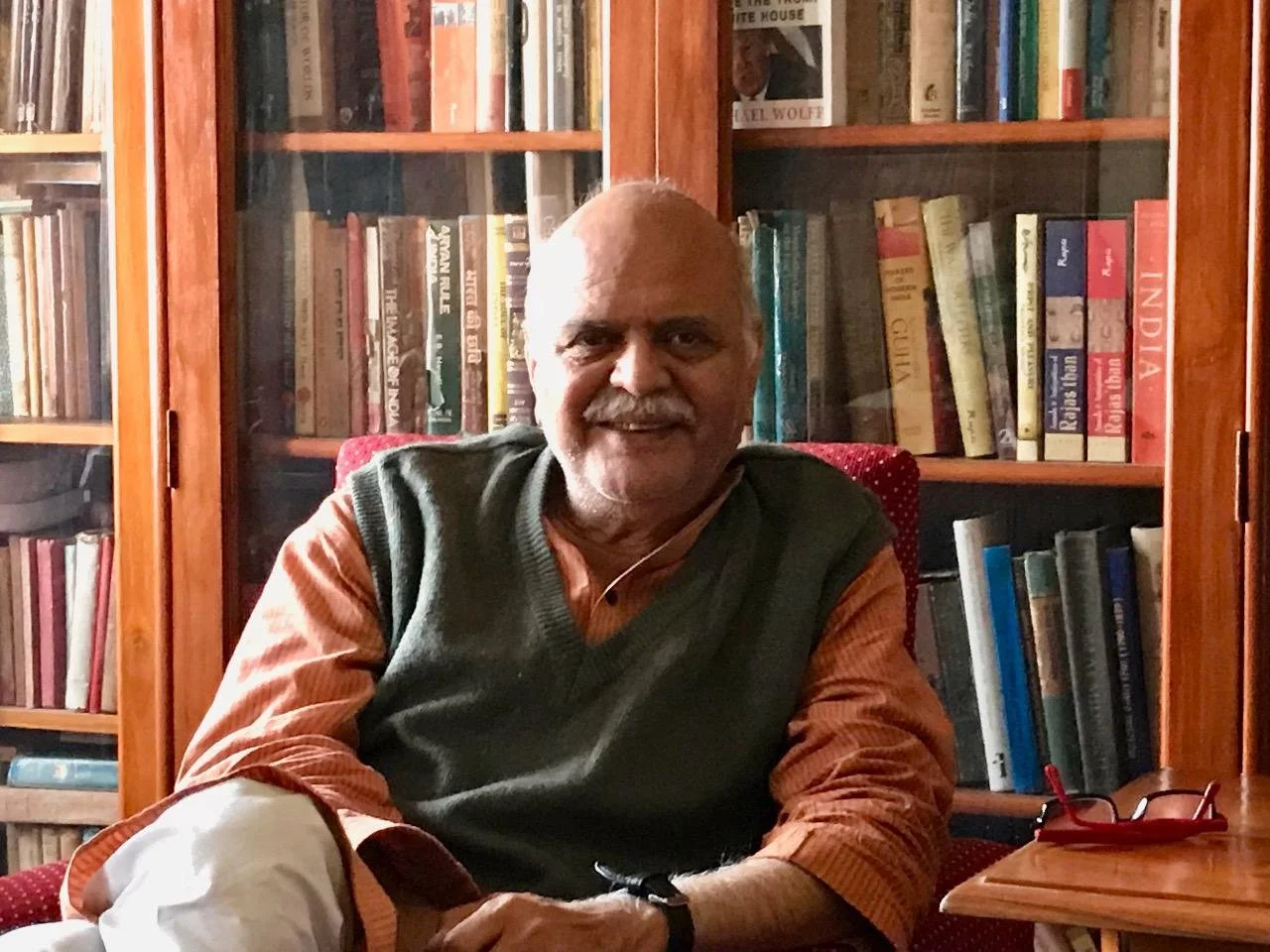
Saleem Kidwai
“If I was to believe in rebirth, I would want to be born gay again.”
– Saleem Kidwai
Though his name remains unfamiliar to most outside of India’s scholarly and LGBTQ+ communities, Saleem Kidwai was nevertheless one of the most influential figures involved in both the preservation and recovery of South Asia’s queer past. As an openly gay teacher, translator, archivist, activist, and medieval historian, Kidwai played a pivotal role in gathering and providing significant historical evidence necessary to challenge the pervasive belief that homosexuality was foreign to Indian culture. Perhaps Kidwai’s most significant accomplishment was his involvement as a co-editor — alongside scholar Ruth Vanita — of the groundbreaking anthology Same-Sex Love in India: Readings from Literature and History, which collected more than two thousand years of writings about same-sex desire from Hindu, Buddhist, Muslim, and modern literary traditions. The book became a foundational text within Indian queer studies and was later cited during the legal battles that ultimately led to the decriminalization of consensual same-sex relationships in the country. Kidwai’s activism also involved nurturing some of Delhi’s earliest gay organizations, answering telephone helplines, counseling young people and their families, opening his homes to queer people in need of companionship, and mentoring generations of future writers, scholars, filmmakers, and activists. While many gay Indians during his time faced pressure either to marry or emigrate, Kidwai built a life around scholarship, cultural preservation, and chosen family, all the while working to ensure that queerness was not an interruption within Indian history but an integral part of it.
Saleem Kidwai was born on August 7th, 1951, in Lucknow, the capital of the state Uttar Pradesh in northern India. He belonged to a prominent Muslim family with longstanding roots in Badagaon, a small village in the nearby Barabanki district, where members of the extended Kidwai family had resided since at least the eighteenth century. The extended Kidwai family included landowners, lawyers, writers, politicians, religious scholars, Sufis, and participants in the Indian independence movement. Kidwai himself was raised within an environment that placed considerable value upon education, public responsibility, and the cultural traditions of the region known as Awadh. Kidwai spent his first seventeen years of life being raised in Lucknow and he later recalled realizing at a young age that he was somehow “different.” Meanwhile, the city’s sophisticated traditions of poetry, music, conversation, etiquette, and hospitality would profoundly influence him, but he would concurrently also understand that its close-knit social world offered him limited freedom as a young gay man. Consequently, in 1968, Kidwai moved to Delhi, ostensibly to further pursue his education but also in search of a larger world in which he might begin to understand and explore his sexuality.
In Delhi, Kidwai studied history at St. Stephen’s College, one of the most prestigious institutions affiliated with the University of Delhi. He then completed his master’s degree in 1973 and was hired to teach medieval and Mughal history at Ramjas College. During these early and formative years, Kidwai’s education was not just confined to the classroom, as his family also had longstanding connections to Begum Akhtar, the celebrated singer whose life bridged the worlds of the courtesan and the modern professional performer. While studying in Delhi in the late 1960s, Kidwai and his close friend, the future poet Agha Shahid Ali, became devoted admirers of Akhtar and attended as many of her concerts and private musical gatherings as they could. Akhtar developed a particular affection for the two young queer men and reportedly remained with them after other guests had departed, sharing stories about her life and career. Kidwai began to record her private performances and collect commercially released tapes, newspaper photographs, articles, and other memorabilia related to her. Following Akhtar’s death in 1974, he created handmade covers for his recordings using photocopied images collected from newspapers and magazines. This painstaking effort would ultimately foreshadow the archival instinct that would later define his queer scholarship: whenever Kidwai encountered a cultural history in danger of disappearing, he would carefully preserve the fragments from which it might one day be able to be reconstructed.
Still only in his early twenties, Kidwai had already begun to live what his friend Shohini Ghosh later characterized as a confident but discreet gay life. While he was open with his sisters and with many close friends, he could not yet discuss his sexuality as freely in every professional or public setting. At the time, consensual sexual activity between people of the same sex remained criminalized under Section 377 of the Indian Penal Code. This law, introduced by the British colonial government in 1861, specifically punished “carnal intercourse against the order of nature,” with as many as ten years in prison. And though it was not consistently enforced through prosecutions, its existence nevertheless encouraged police harassment, blackmail, family pressure, and social secrecy. Gay men of Kidwai’s generation were thus frequently expected to either suppress their desires, enter heterosexual marriages, or leave India entirely in search of greater freedom abroad. Kidwai himself would briefly choose the third option, though the experience ultimately convinced him that the supposedly liberated West would also offer no guarantee of refuge from homophobia.
In 1976, Kidwai received leave from the University of Delhi and moved to Montreal to pursue a doctorate in Islamic history at McGill University. Although his academic ambitions were genuine, Kidwai later acknowledged that he was also searching for the greater sexual freedoms he imagined might be available to him in the West. Indeed, Montreal possessed a lively gay subculture of bars, discos, political organizations, and social networks, and Kidwai immersed himself enthusiastically within it. There he formed friendships and romantic relationships with gay men, drag performers, and transgender people, and became particularly close to the Indian-born photographer Sunil Gupta, who helped introduce him to the city’s queer social life. For Kidwai, the experience initially seemed to offer what Delhi could not: public spaces where gay people could meet one another without relying entirely upon coded introductions or private gatherings. But this apparent freedom still nevertheless existed alongside aggressive police surveillance, and experiencing this contradiction between visible queer community and state repression would soon become painfully clear to Kidwai.
On the night of October 21st into October 22nd, 1977, more than fifty Montreal police officers raided the gay bars Truxx and Le Mystique. Some of the officers wore bulletproof vests and carried machine guns, treating the patrons as though they posed a serious public threat. Kidwai was among the 146 men arrested and he and his fellow detainees were held for approximately fifteen hours without bail.They were compelled to undergo testing for venereal disease, photographed, fingerprinted, and threatened with criminal prosecution. The raid was one of the largest mass arrests in Canada since the October Crisis of 1970, a period of domestic terrorism and political unrest in Canada sparked by the kidnapping of two officials by the militant separatist group Front de libération du Québec (FLQ). The following evening, approximately two thousand people gathered at the intersection of Stanley and Sainte-Catherine Streets to protest the arrests, which helped galvanize a more forceful gay rights movement throughout Quebec. In December of that year, the province amended its Charter of Human Rights and Freedoms to prohibit discrimination on the basis of sexual orientation, becoming the first major jurisdiction in North America to enact such a protection. Nevertheless, the individual charges stemming from the raid remained unresolved for years, and those against most of the men were not fully dismissed until as late as 1982.
For Kidwai, the arrest proved to be both traumatizing and politically transformative. As a foreign student, he feared that the subsequent criminal proceedings would lead to his deportation, while having to make periodic court appearances rendered it difficult to continue his academic work. More fundamentally, the raid destroyed his belief that relocating to a Western city would necessarily allow him to live more freely. He experienced firsthand in Canada that the same society that supported gay bars and a visible homosexual subculture could still send armed police officers into those spaces and treat their occupants as criminals. Given all this, Kidwai ultimately concluded that he was too vulnerable as an immigrant to contribute meaningfully to the political struggle in Canada, and he abandoned the pursuit of his doctorate there to return to India. Rather than interpreting his return as a retreat into silence, however, he came to believe that whatever contribution he could make toward gay liberation would have to occur within the society to which he originally belonged.
Back in Delhi, Kidwai resumed teaching at Ramjas College, where he remained until 1993. His lectures on medieval Indian history became remarkably popular, with former colleagues recalling that students from other colleges would often regularly crowd into his classes. Kidwai became respected in particular for both his extensive knowledge and for his ability to communicate history as something contested, politically consequential, and intimately connected to the present. This became particularly evident in the early ‘90s when Hindu nationalist organizations mobilized around claims that the Babri Masjid in Ayodhya had been constructed over the birthplace of the Hindu deity Rama. The mosque’s destruction by a large mob in December 1992 deeply disturbed Kidwai, both because of the anti-Muslim violence it helped unleash and because he saw that medieval history was being selectively manipulated to justify contemporary political goals. For Kidwai, distorted accounts of the medieval past could be used both to inflame religious hatred and to erase forms of sexuality that did not fit modern nationalist ideas of Indian tradition, and his insistence upon examining historical evidence carefully would later become central to his queer scholarship.
As Kidwai gradually became more open about his sexuality, his presence also began altering the attitudes of students, colleagues, relatives, and friends. While he was not a confrontational public figure, he made gay life recognizable through the ordinary dignity with which he lived it. Kidwai’s friend Shohini Ghosh later observed that homosexuality became more acceptable to many of Kidwai’s contemporaries simply because he was the person through whom they encountered it. His South Delhi apartment, meanwhile, developed into a vibrant social center where queer and heterosexual friends, writers, academics, artists, and activists alike gathered for meals, music, alcohol, conversation, and parties. Kidwai believed that movements organized around rights and survival also required spaces of happiness and pleasure, and the convivial life surrounding Kidwai’s home thus became an important aspect of his activism, one that quietly modeled the communities gay Indians might create for themselves even before the law recognized their right to exist.
Around 1990, Kidwai also participated in an early gay gathering called Red Rose, held at the Indian Coffee House in Delhi. Because there were no openly gay bars or community centers in the city, a red rose placed on a table served as a discreet signal informing other gay men that they could safely approach. While such coordinated arrangements may appear modest in retrospect, during a time when exposure could lead to arrest, blackmail, professional consequences, or forced marriage, simply gathering openly enough to recognize one another represented a meaningful act of resistance. During this period, Kidwai also became close to Siddhartha Gautam, a young lawyer and activist who had returned to India after studying abroad and who helped establish the AIDS Bhedbhav Virodhi Andolan, or AIDS Anti-Discrimination Movement. After Gautam’s premature death in 1992, Kidwai and other friends helped organize the Siddhartha Gautam Film Festival in 1993, generally remembered as Delhi’s first known queer film festival. Altogether, these early gatherings and screenings helped turn a collection of isolated individuals into a more self-conscious LGBTQ+ community, establishing personal networks that would later sustain larger organizations and political campaigns.
Kidwai took voluntary retirement from Ramjas College in 1993, freeing him from some of the professional caution that had previously accompanied his public activism. Throughout the decade, he became an increasingly visible participant in conferences, television programs, gay discussion groups, and community organizations. In 1999, he helped nurture Humrahi, a gay group that met at the Delhi offices of the Naz Foundation, an organization focused on sexual health and HIV prevention. Humrahi organized conversations and film screenings and maintained a telephone helpline for men trying to understand their sexuality, cope with family pressure, or obtain assistance after harassment. Despite his scholarly stature, Kidwai regularly answered calls himself and offered to meet parents who were struggling to accept a gay child, joking that his age and status as a professor sometimes made families more willing to listen. Rather than dictating a single model of gay identity, Kidwai focused instead upon making sure that isolated people knew that someone like them would always be available who would neither condemn nor abandon them.
Such brazen efforts by Kidwai all took place amid conditions in which Section 377 endangered not only sexual intimacy but also community organizing and public health. Police could use the law to extort money from men meeting in public spaces, while the possibility of prosecution made victims reluctant to report violence or abuse. HIV/AIDS organizations attempting to distribute condoms and safer-sex information at the time were often accused of encouraging criminal behavior. These continuing dangers became especially apparent in July 2001, when police in Lucknow raided the offices of the Naz Foundation International and Bharosa Trust and arrested four staff members who worked with men who had sex with men. The so-called Lucknow Four were imprisoned for forty-seven days, while police characterized HIV-prevention literature as obscene material and charged the workers under Section 377. The arrests occurred the year after Kidwai’s major anthology first appeared, demonstrating how urgently historical visibility, legal reform, and practical community support remained intertwined.
It was also during the early 1990s when Kidwai’s archival habits began developing into the work for which he would become best known. Over the years, he had saved every passage he encountered in Persian or Urdu literature that described affection, desire, or sexual relationships between people of the same sex. When he met Delhi University literature scholar and feminist writer Ruth Vanita, he discovered that she had created a similar private collection from Sanskrit, Hindi, Bengali, and other literary traditions. Queer studies scarcely existed as an academic discipline in India at the time, and texts that contained homoerotic themes were frequently mistranslated, minimized, or ignored altogether. Kidwai and Vanita thus began to combine their personal archives and contact other scholars capable of translating works from additional languages, and what started as the private collecting habits of two queer readers gradually became an enormous effort to recover the many forms in which same-sex love had appeared across Indian literary and historical traditions.
The resulting anthology, Same-Sex Love in India: Readings from Literature and History, was first published in 2000. Spanning more than two thousand years and drawing from fifteen languages, the collection included excerpts from religious epics, poems, stories, biographies, historical chronicles, letters, and modern fiction, while its materials emerged from Hindu, Buddhist, Muslim, and secular traditions, ranging from the Mahabharata and ancient Sanskrit works to medieval Persian histories, Urdu poetry, colonial-era literature, and twentieth-century narratives. The book documented the varied ways in which intimacy, eroticism, devotion, friendship, gender transformation, and same-sex attachment had been understood across different periods, without claiming that every individual represented within these sources possessed a modern gay or lesbian identity. Still, by placing these varied writings beside one another, Kidwai and Vanita demonstrated that queer desire did not suddenly enter India through Western culture during the late twentieth century, but that it had existed throughout the subcontinent’s extensive history, even if the language and social meanings attached to it had continually shifted and transformed.
Kidwai himself was chiefly responsible for the anthology’s medieval Persian and Urdu materials, and his contribution was especially important because it prevented Indian queer history from being reduced to Sanskrit mythology or Hindu temple imagery. He translated and contextualized writings associated with figures such as Amir Khusro and the fourteenth-century historian Ziauddin Barani, as well as Persian and Urdu poems in which male speakers addressed male beloveds. He also examined historical accounts of rulers, courtiers, servants, Sufis, poets, and other men whose same-sex attractions were frequently recorded without the kind of categorical condemnation imposed by later colonial morality. Additionally, Kidwai explored the homoerotic metaphors of Sufi literature, where human longing for a male beloved could become a means of expressing the soul’s yearning for the divine, and discussed Rekhti, a form of Urdu poetry in which male poets sometimes adopted women’s voices to describe intimacy with other women. In all, his work established that Muslim literary traditions were not peripheral to South Asian queer history but central to it, complicating attempts by both religious conservatives and Hindu nationalists to portray homosexuality as incompatible with Islam or foreign to the Indian past.
Given its subject matter, however, finding a publisher for the anthology proved difficult. Kidwai and Vanita worked without significant institutional funding, and every Indian publisher initially approached with the manuscript reportedly rejected it. The book was finally released in the United States in 2000, followed by a paperback edition and an Indian publication soon afterward. It was soon named a finalist for a Lambda Literary Award and gradually gained recognition among scholars, students, lawyers, and activists. In 2008, Penguin India issued an expanded and updated edition, and the book continued through numerous printings before being reissued again in 2022 under the subtitle A Literary History. Its accessibility proved to be just as important as its academic rigor, as queer readers who had long been taught that their desires made them alien to their families, religions, or nation could now encounter centuries of people who had loved, desired, mourned, and written about members of their own sex.
Same-Sex Love in India also moved beyond classrooms and into the struggle against Section 377. In 2001, the Naz Foundation filed a constitutional challenge to the law, beginning a prolonged legal battle over whether the state could criminalize consensual sexual activity between adults. In 2009, the Delhi High Court ruled that applying Section 377 to private consensual acts violated the constitutional rights to equality, dignity, privacy, and personal liberty. That victory was reversed by the Supreme Court in 2013, only for a larger constitutional bench to finally strike down the law’s application to consenting adults on September 6th, 2018. Kidwai and Vanita’s anthology was cited in both the 2009 Delhi High Court judgment and the 2018 Supreme Court proceedings, providing essential historical evidence against the claim that homosexuality represented a recent Western intrusion. Kidwai also helped gather support from prominent public figures during the litigation. While the book did not, by itself, overturn Section 377, it helped lawyers and activists challenge the claim that the law protected Indian tradition and showed that same-sex desire had long been part of Indian life, while Section 377 had only been introduced later under colonial rule.
Kidwai’s additional scholarly pursuits also extended well beyond queer history. In 2003, he edited and translated Song Sung True, the autobiography of celebrated Pakistani singer Malka Pukhraj, who had begun her career as a child performer at the court of Maharaja Hari Singh of Jammu and Kashmir. The memoir preserved Pukhraj’s distinctive voice while documenting courtly culture, musical training, migration, and the political transformations accompanying Partition. Kidwai subsequently translated The Mirror of Wonders and Other Tales by the little-known Urdu writer Syed Rafiq Hussain in 2012. The collection’s stories, narrated largely through the experiences of animals, used satire and empathy to expose human cruelty and introduced English-language readers to a writer whose unusual body of work might otherwise have remained inaccessible. Perhaps Kidwai’s most demanding translation projects were two novels by Qurratulain Hyder, one of the most important Urdu writers of the twentieth century. Hyder had translated or, as she sometimes described it, “transcreated” several of her own novels into English, but Kidwai became the only other person to translate her novels extensively. His English version of Chandni Begum appeared in 2017, and in 2019, he published Ship of Sorrows, his translation of Hyder’s 1952 novel Safina-e-Gham-e-Dil. Hyder’s dense literary allusions, movements between narrative voices, shifts in style, and occasionally unreliable printed texts made her work notoriously difficult to translate and Kidwai’s versions therefore required not only linguistic fluency but also extensive historical and cultural research.
Kidwai’s grand ambitions and exacting standards, however, could also prevent him from completing projects. For decades, friends encouraged him to write a full biography of Begum Akhtar, but he worried that doing so might violate the confidence she had placed in him during their private conversations. In 2008, he received a senior research fellowship for a proposed study and even completed a promising preliminary draft, but he never finalized the work for publication. Ghosh later described him as a hesitant writer who scrutinized every assertion so rigorously that he sometimes preferred not to publish at all rather than release something he considered inadequate. These unfinished projects represent genuine losses, particularly because Kidwai possessed personal memories and archival knowledge unavailable to later historians. Nevertheless, the many works that Kidwai did complete throughout his lifetime reveal a consistent intellectual purpose — to recover voices that had been marginalized, mistranslated, or stranded beyond the reach of new readers.
By the early 2000s, Kidwai had returned to Lucknow, the city in which he had always hoped eventually to live. His home in the Mahanagar neighborhood turned into another open gathering place for friends, scholars, and writers, and he became closely involved with efforts to preserve Lucknow’s pluralistic cultural history. Kidwai likewise became a mentor to Lucknow’s emerging queer community. He attended Pride events, participated in the 2019 Awadh Queer Literature Festival, offered advice to younger activists, and welcomed LGBTQ+ visitors into his home. Friends recalled that his life itself offered reassurance to people who feared that being openly gay meant forfeiting family, intellectual seriousness, or social belonging, even though he was single for much of his later life and did not regard marriage as the necessary culmination of either love or queer liberation. In fact, Kidwai retained an affinity for an older gay politics centered on sexual freedom, friendship, and chosen kinship, although he did not disparage those who wanted gay marriage. His own conception of ishq, or love, extended beyond romance to encompass friendships sustained through decades of care, creating a queer family around him that was broad, intergenerational, and resistant to a strict division between the heterosexual and LGBTQ+ worlds.
Towards the end of his life, Kidwai never hardened into the belief that legal progress had completed the work of liberation. He lived to see Delhi’s first gay nights, India’s first Pride marches, the growth of queer publishing and film, and the final reading down of Section 377 — developments he had once scarcely imagined possible. But he nevertheless continued to remind younger activists that decriminalization represented only one step and he continued to express concern about the persistence of Islamophobia, ageism, class prejudice, and body-shaming, including within LGBTQ+ communities themselves. He also resisted any politics that made ideological agreement a prerequisite for human contact, keeping his telephone and home open to people with differing viewpoints so long as they approached others without hatred.
Between 2010 and 2011, Kidwai served as one of the participants in Project Bolo, an oral-history initiative created by filmmaker Sridhar Rangayan, the Humsafar Trust, and Solaris Pictures, which aimed to document the lives of Indian LGBTQ+ people who had challenged social norms. Speaking about his childhood, scholarship, activism, and evolving relationship to his sexuality, Kidwai reflected that he would choose to be born gay again and added that, despite the hardships involved, he had experienced considerable fun. Kidwai did not deny the arrest, secrecy, discrimination, or legal persecution that had shaped his life but instead rejected the idea that gay existence should be narrated only by suffering. For him, queer happiness was neither politically trivial nor something that had to be postponed until complete equality was achieved. It was one of the very things liberation was supposed to protect.
A decade later, Saleem Kidwai died at the age of seventy on August 30th, 2021, following heart-related complications and cardiac arrest. He was buried amid heavy rain in his ancestral town of Badagaon in the Barabanki district. News of his passing produced an outpouring of grief among former students, scholars, writers, filmmakers, artists, lawyers, and LGBTQ+ activists throughout India, with many of the tributes emphasizing both the importance of his literary output as well as his generosity with knowledge. Multiple scholars noted that Kidwai rarely guarded an idea in the hope of receiving personal recognition, and recalled that he regularly encouraged younger historians to document their own experiences so that future generations would understand how India’s queer movement had developed. Friends, meanwhile, remembered him as a brilliant but humble individual, a meticulous translator, an affectionate host, a dependable counselor, and a person whose quiet example had made it easier for them and for countless others to accept themselves.
Since his passing, Kidwai’s legacy has only continued to expand. In 2025, the feminist organization Nirantar Trust released the short documentary Queering the Pitch: Life and Times of Saleem Kidwai, which presents his life as an example of a broader queer worldview. That same year, the Rainbow Lit Fest posthumously honored Kidwai with its Lifetime Achievement Award. Meanwhile, Same-Sex Love in India remains in print and continues to serve as a central text for students, historians, activists, and general readers trying to understand the long history of queer desire across South Asia. Collectively, these commemorations have begun to preserve not just Kidwai’s principal publication but also the social and cultural world he created around it.
Ultimately, Saleem Kidwai’s significance to LGBTQ+ history cannot be measured solely through the number of organizations he joined, public appearances he made, or court cases in which his scholarship was cited. His greatest contribution, overall, was helping queer Indians recognize themselves as historical subjects rather than recent problems imported from somewhere else. By recovering Persian, Urdu, Sanskrit, Hindi, and other writings, Kidwai — alongside Vanita — offered evidence that same-sex desire had always existed within India’s religious, literary, and cultural traditions. And by living openly, answering helplines, counseling families, and welcoming people into his home, Kidwai translated that historical argument into an everyday social reality, proving that activism can take many forms. Through his writing, translation, teaching, archiving, and expansive practice of friendship, Saleem Kidwai helped reclaim a queer past while creating more livable possibilities in the present. His jocular wish to be ‘born gay again' was therefore not just a witty expression of self-acceptance, but it summarized the quiet yet radical principle upon which he built his life: that queerness, despite everything society had done to punish it, remained something worth choosing again and again.
REFERENCES AND FURTHER READING
Disclaimer: some of the sources may contain triggering material
Archives gaies du Québec. (n.d.). Fonds Truxx (AGQ-F0129). https://agq.qc.ca/en/agq-f0129/
Canadian Museum of History. (n.d.). Counter-protest flyer following arrests at Truxx in October 1977. https://www.historymuseum.ca/teachers-zone/2slgbtqia-history-and-identities-in-canada/community-and-protest/counter-protest-flyer-following-arrests-at-truxx-in-october-1977/
Davé, N. N. (2012). Queer activism in India: A story in the anthropology of ethics. Duke University Press. https://doi.org/10.1215/9780822395683
da Penha, M. (2021, September 2). Saleem Kidwai stood against the tide, in life and work. Mint Lounge. https://www.livemint.com/mint-lounge/ideas/saleem-kidwai-stood-against-the-tide-in-life-and-work-111630500986982.html
George, R. M., Chatterjee, I., Gopinath, G., Naim, C. M., Patel, G., & Vanita, R. (2002). Tracking “same-sex love” from antiquity to the present in South Asia. Gender & History, 14(1), 7–30. https://doi.org/10.1111/1468-0424.00250
Ghosh, S. (2021, September 5). For Saleem Kidwai, a politics of resistance was impossible without pleasure. The Wire. https://m.thewire.in/article/history/for-saleem-kidwai-a-politics-of-resistance-was-impossible-without-pleasure/amp
Goldenberg, S. (2021, September 2). Saleem Kidwai, scholar who unearthed long-buried literature on gay love in India, dies at 70. The Washington Post. https://www.washingtonpost.com/local/obituaries/saleem-kidwai-dead/2021/09/02/662ec93c-0a90-11ec-aea1-42a8138f132a_story.html
Human Rights Watch. (2002). Epidemic of abuse: Police harassment of HIV/AIDS outreach workers in India. https://www.hrw.org/reports/2002/india2/india0602-05.htm
Human Rights Watch. (2006, January 11). India: Repeal colonial-era sodomy law. https://www.hrw.org/news/2006/01/11/india-repeal-colonial-era-sodomy-law
Hussain, S. R. (2012). The mirror of wonders and other tales (S. Kidwai, Trans.). Yoda Press.
Hyder, Q. (2017). Chandni Begum (S. Kidwai, Trans.). Women Unlimited. (Original work published 1989)
Hyder, Q. (2019). Ship of sorrows (S. Kidwai, Trans.). Women Unlimited. (Original work published 1952)
Jaffer, M. (2021, August 30). Farewell, Saleem Kidwai. Hindustan Times. https://www.hindustantimes.com/books/farewell-saleem-kidwai-101630332364000.html
Kalidas, S. (2021, October 7). Remembering Begum Akhtar and Saleem Kidwai. The Wire. https://m.thewire.in/article/culture/remembering-begum-akhtar-and-saleem-kidwai
Mehra, C. (2021, September 2). Remembering Saleem Kidwai: Friend, scholar, queer rights activist. The Indian Express. https://indianexpress.com/article/opinion/columns/remembering-saleem-kidwai-friend-scholar-queer-rights-activist-7483269/
Narrain, A., & Bhan, G. (Eds.). (2005). Because I have a voice: Queer politics in India. Yoda Press.
Penguin Random House India. (2022). Same-sex love in India: A literary history. https://www.penguin.co.in/book/same-sex-love-in-india/
Pukhraj, M. (2003). Song sung true: A memoir (S. Kidwai, Ed. & Trans.). Kali for Women.
Rangayan, S. (Director). (2012). Project Bolo: Vol. 1, 2010–2011 [Documentary series]. The Humsafar Trust & Solaris Pictures. https://search.worldcat.org/title/874967115
Rangnekar, S. D. (2021, September 3). A tribute to Saleem Kidwai, a man who made a real contribution to India’s LGBTQ community. Hindustan Times. https://www.hindustantimes.com/books/a-tribute-to-saleem-kidwai-a-man-who-made-a-real-contribution-to-india-s-lgbtq-community-101630576812737.html
Rao, R. R. (2021, August 31). Saleem Kidwai (1951–2021): A pioneering historian of same-sex love in India. Scroll.in. https://scroll.in/article/1004201/saleem-kidwai-1951-2021-a-pioneering-historian-of-same-sex-love-in-india
Rehman, A. (2021, August 31). Saleem Kidwai (1951–2021): “Generous, encouraged people to be comfortable with their sexuality.” The Indian Express. https://indianexpress.com/article/india/saleem-kidwai-dead-generous-encouraged-people-to-be-comfortable-with-their-sexuality-7479198/
Scroll Staff. (2025, December 8). Rainbow Lit Fest, focusing on queer stories, announces its 2025 writing awards. Scroll.in. https://scroll.in/article/1089098/rainbow-lit-fest-focusing-on-queer-stories-has-announced-its-2025-writing-awards
Supreme Court Observer. (2018, September 6). Judgment of the Court in plain English: Constitutionality of Section 377 IPC. https://www.scobserver.in/reports/navtej-singh-johar-section-377-judgment-of-the-court-in-plain-english/
The Third Eye. (2025, August 30). Queering the pitch: Life and times of Saleem Kidwai. https://thethirdeyeportal.in/nirantar-video/queering-the-pitch-life-and-times-of-saleem-kidwai/
Université du Québec à Montréal. (n.d.). Arrestation massive d’homosexuels. Chronologie de Montréal. https://chronomontreal.uqam.ca/chronologie/2631-arrestation-massive-dhomosexuels
Vanita, R., & Kidwai, S. (Eds.). (2000). Same-sex love in India: Readings from literature and history. Palgrave Macmillan. https://doi.org/10.1007/978-1-349-62183-5